
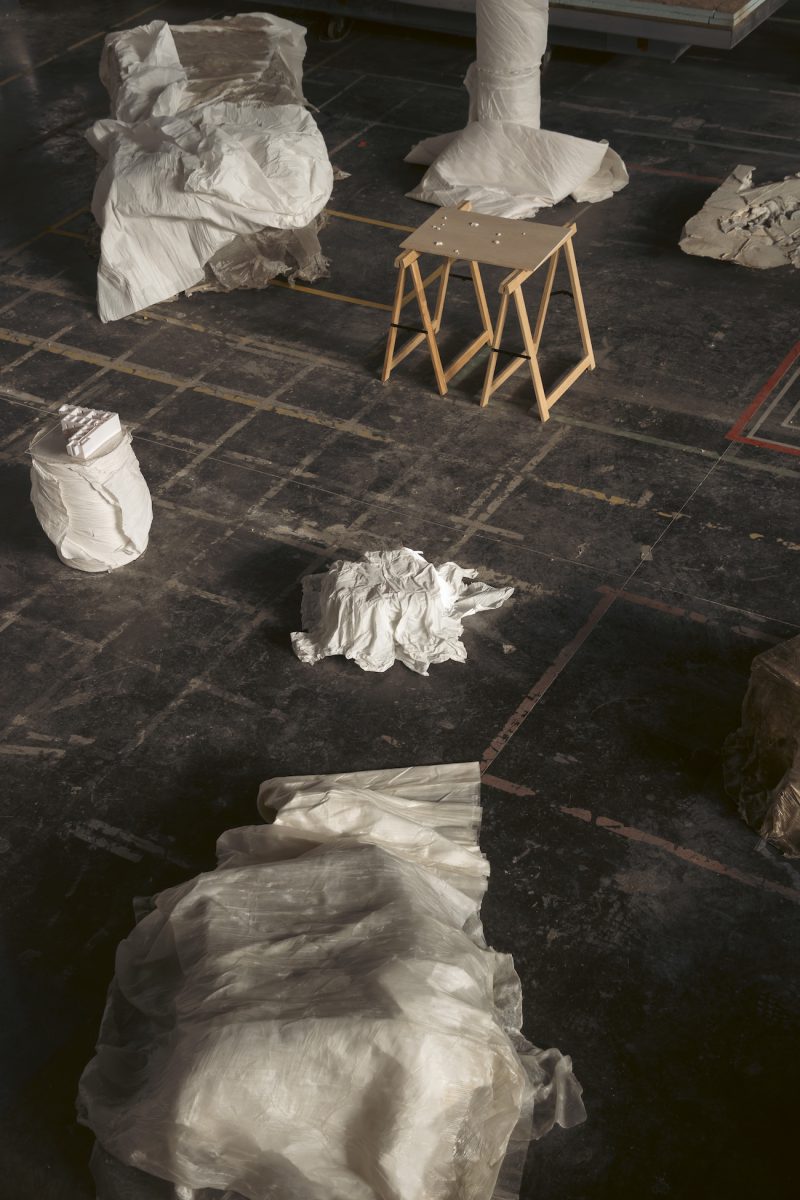
This Milan Design Week, Issey Miyake in collaboration with Ensamble Studio, presents The Paper Log, Shell and Core as two parallel interpretations of what was once a simple paper waste material: the delicate paper lining that formed the iconic pleating of Issey Miyake garments.
Bound and compressed into what became the Paper Log, more than just the physical object; the memory of the garment and its imprints become molded, bent, and formed into structure in furniture (Core) and sculpture (Shell). In conversation with Satoshi Kondo, design director at Issey Miyake, and Antón García-Abril and Débora Mesa of Ensamble Studio, The Paper Log, Shell and Core reveals an ongoing inquiry into material memory and how its shaping can melt the boundaries between body and space, art and architecture, garment and form.
Athena Kuang: You encountered the Paper Log at the manufacturer’s site. What about it spoke to you, that it could be transformed from something that was pure waste to potential in creation?
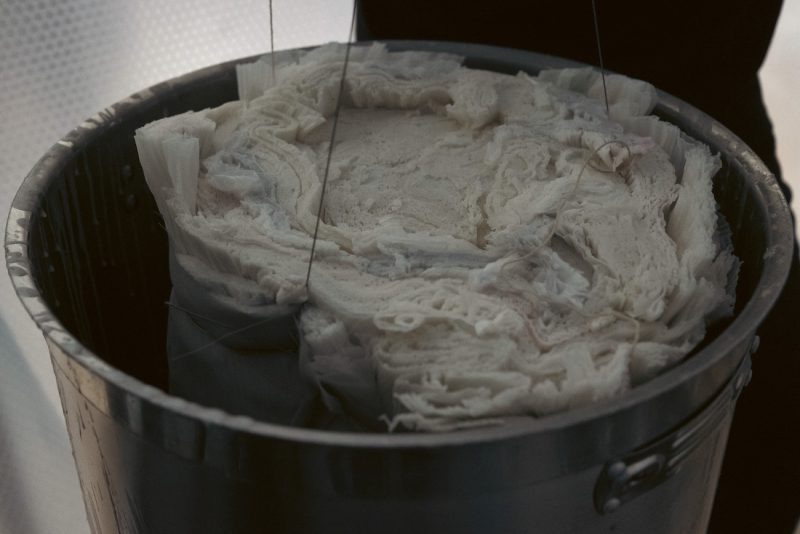
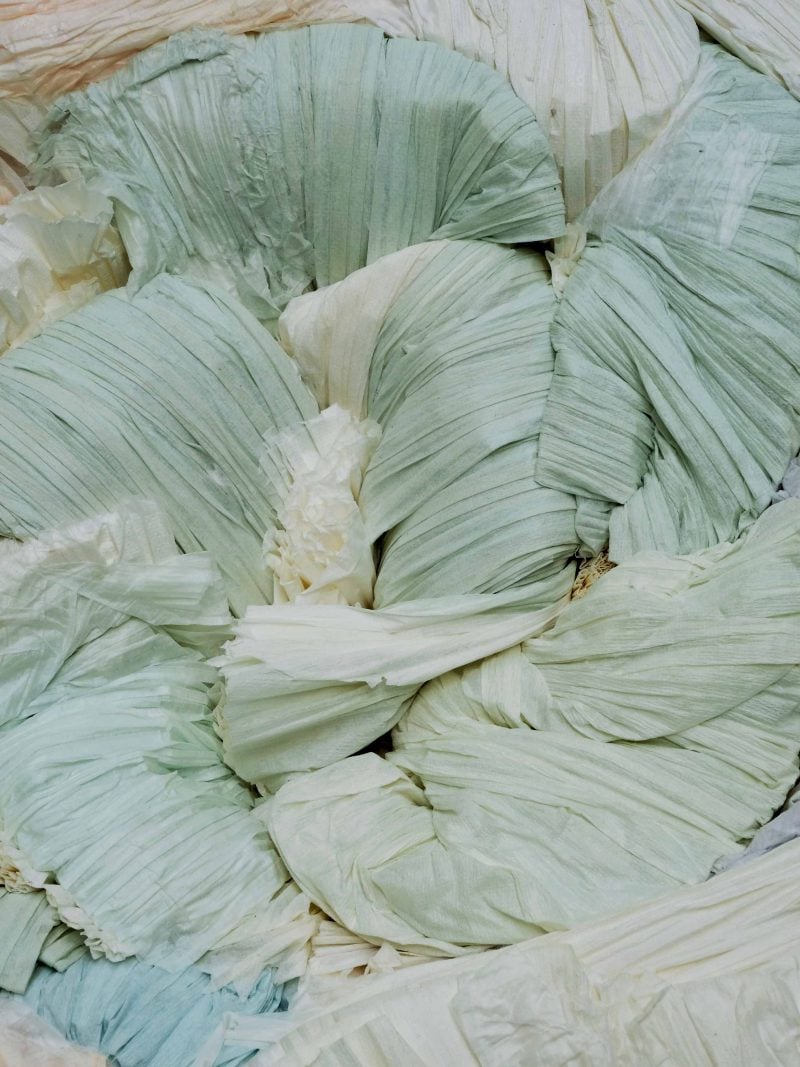
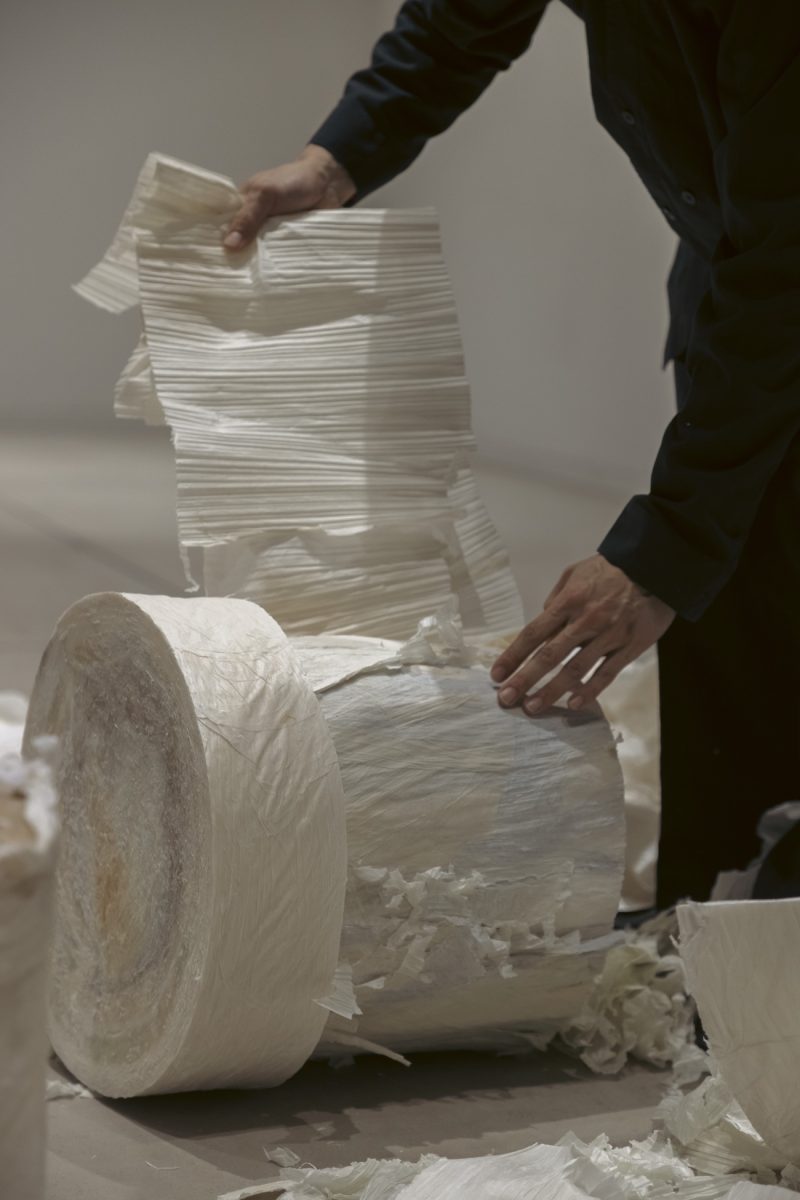
Satoshi Kondo: We always visit the manufacturer. We always go there to find inspiration, to speak to technicians, and it’s mainly a regular visit. It was only about five years ago when I was starting to introduce that paper compressor, and before that, they just wrapped bundles and bundles of the plated paper and recycled or threw them away.
At the moment when I saw the log coming out of the machine, I wanted to cut it open, just to see what goes inside. When you cut it open, every log is different, and everything is unique.
The pleat was originally created back in 1993 for the ease and poetry of everyday living. Miyake imagined the lifestyle in the future, and created this line that’s easy to take care of, and you don’t need to iron it. So there’s this practical, functional aspect that comes with it.
What if now we have the byproduct of the completed line? What if we can also do something to the byproduct and really find new value and repurpose the byproduct?
AK: Your primary discipline is clothing, which is something intimate, mobile, responsive. What changes in your design thinking when the outcome is furniture, not fashion?
SK: We thought we would have a completely different approach, but in the end, we found our approach to be not that different. We had this epiphany that no matter what we approach, whether it’s a piece of cloth, whether it’s a paper log, it’s the same. It takes more or less the same amount of effort and research to really understand the material.
Of course, what you do to a piece of cloth, or to a log is different. But the understanding of discovering, playing with, and knowing what’s so beautiful about it, what’s not so beautiful about it, and to allow that to bring out that quality.
I think the process of approach is the same, whether it’s a log or a piece of cloth. A lot of the work is hands on and you need to really work with it, to grapple with the material.
AK: You describe Core, these prototypes, as only the beginning. Where do you imagine the Paper Log could go next, whether in industry, domestic life, or elsewhere?
SK: I would say both, I can see potential in industries such as architecture, construction material, and also in home decor, or interior, because what you will see in April, we are already using it as a stand for our bags and our merchandise.
I think it will function as furnishing. I think you can already see it being in your home, and maybe there’s one direction there, and also, the bricks that we shared with you, maybe it can work as construction materials.
I think what’s so interesting is it’s still an open-ended exploration and it’s still going. What’s so interesting for fashion or for clothing design is that we have to present periodically, spring summer and autumn winter.
But the research behind it, it’s not punctual anymore, it’s always continued. So you can always see there’s a lineage of what was the thing and what it has become.
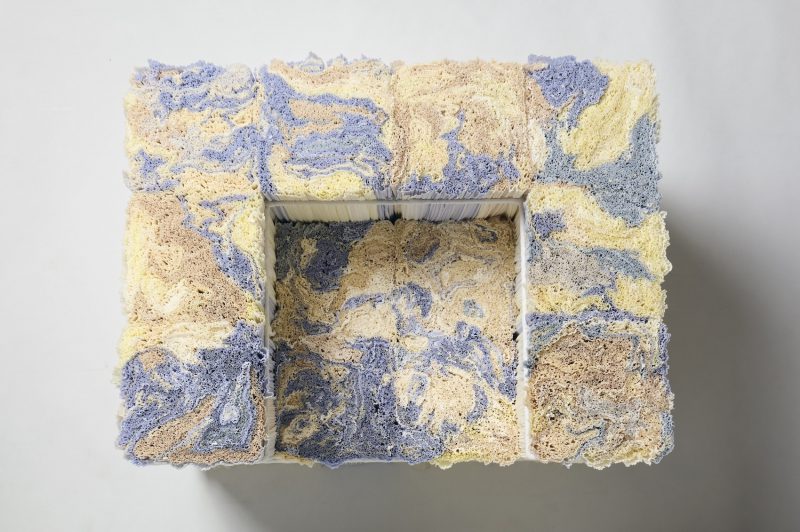
AK: And to continue on with Ensamble Studio, regarding the Shell facet of the Paper log project: if structure defines space, what is structure in a petrified sheet of paper, the Paper Log?
Antón García-Abril, Ensamble Studio: Well, that’s a very beautiful question, because structure in a material that does not have a structure, is finding that space that is able to hold. That is the structure. There’s an association between the order of space and the mechanisms that allow that space to exist. So, the case of the paper is at the extreme position, because it’s paper. It’s almost the minimum structure that anything could have.
But the speciality of it, it’s very rich, and we want them also to connect to the structures or the spaces of the legacy of it. So, we are serving a long memory that is embedded in the material.
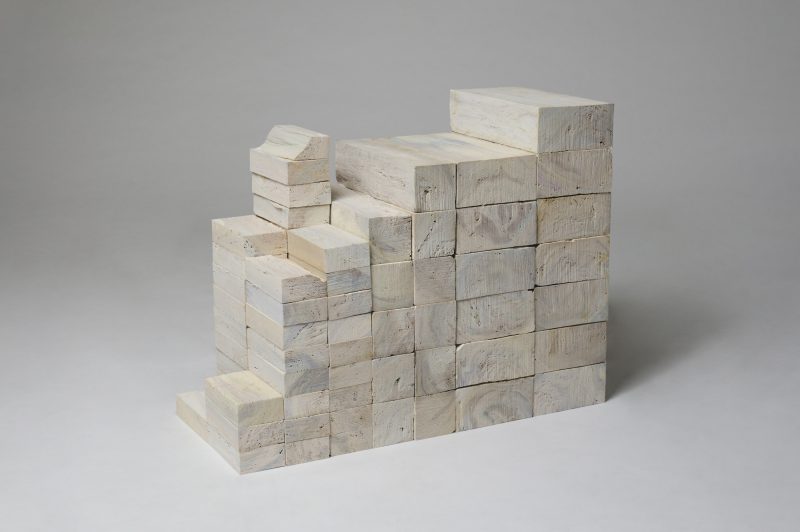
AK: You describe learning from Issey Miyake’s garments how clothing creates space between fabric and flesh. How did this idea of distance, air, and autonomy translate into the objects you created?
AG: Well, I think it’s a very natural observation. We are just somehow emulating in a different body, a body that is not human, it’s a body of a chair, or an obstructed construction. So, I would say it’s a continuation of what we’ve learned.
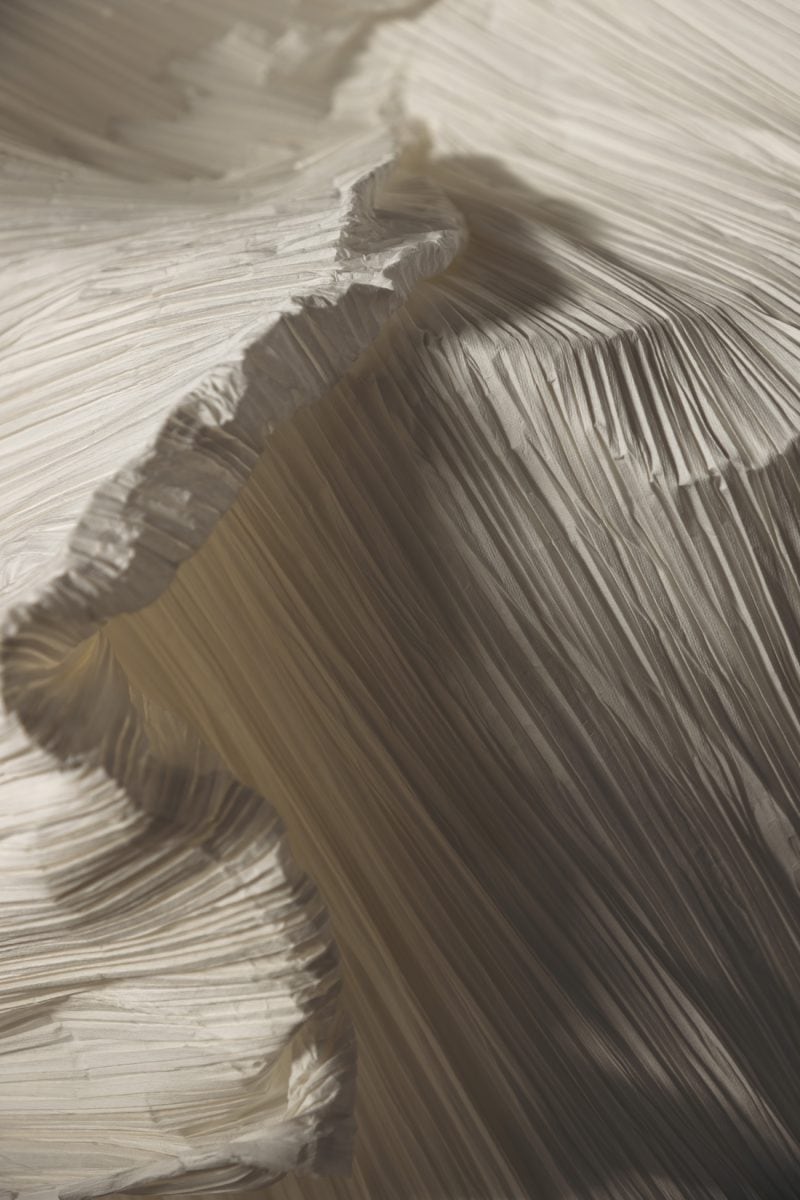
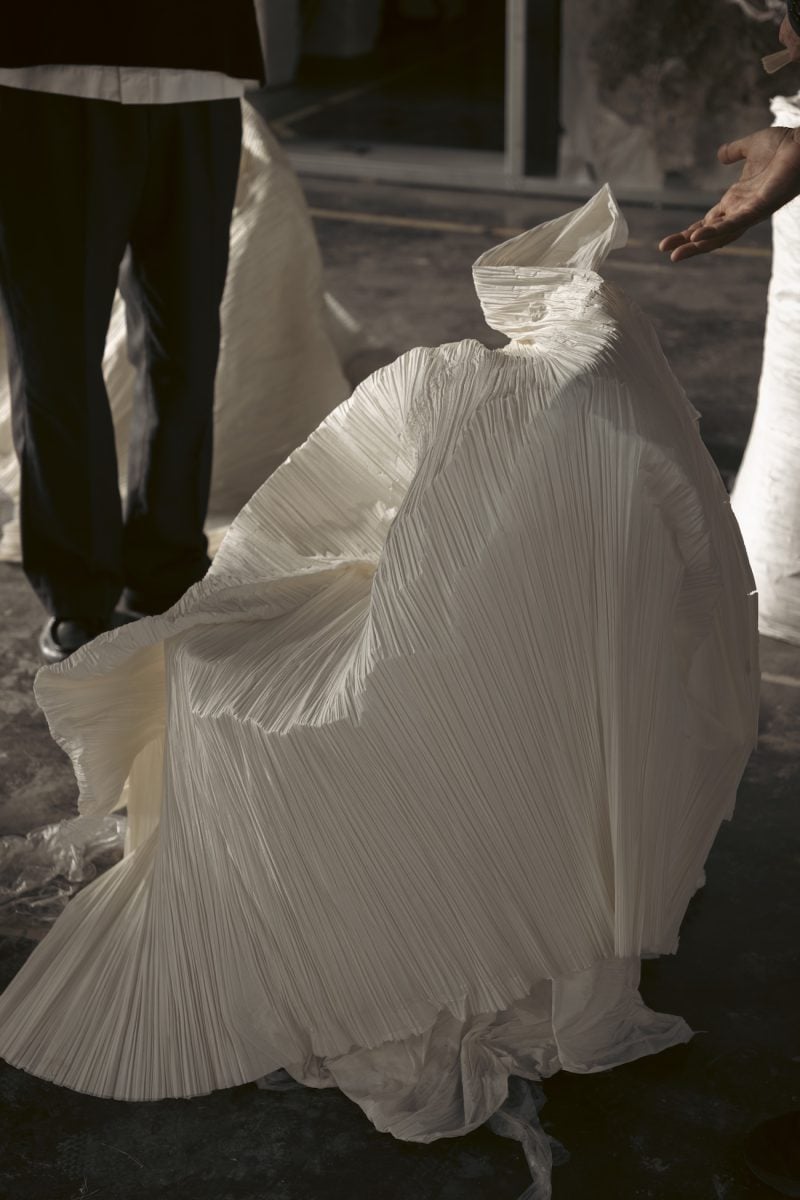
Débora Mesa, Ensamble Studio: What is interesting is that the pleating that is done for the garment, the paper inherits it. The function of the paper is not to pleated, not to be structured. It needs to protect. But when it protects it, it grabs the same structure.
What we love about the pleat is this distance with the body, that protects the body, but does not replicate it.
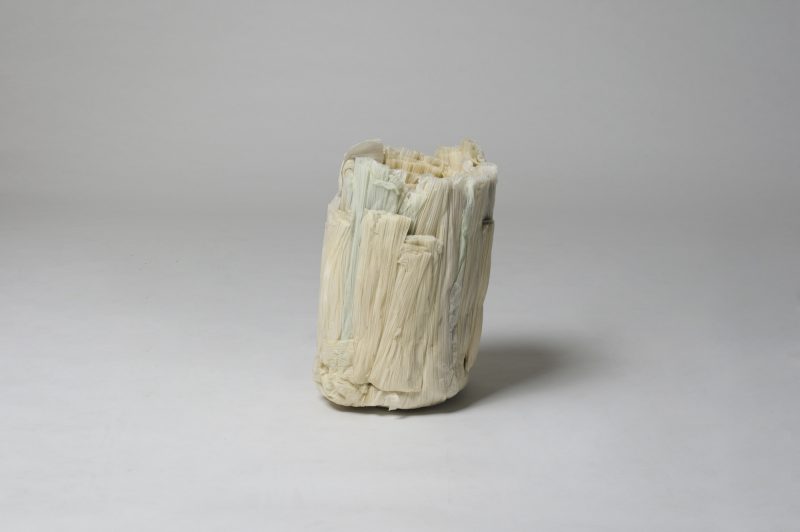
AK: Originally, this paper protected fabric as it moved through the pleating machine. In Shell, it becomes the visible, final surface. What does it mean to elevate a protective intermediary into the primary architectural gesture?
DM: Keeping the form is always something that architecture, art tries to do. To take anything that is available and try to do a series of operations, supplying a little more energy to it to make something. In our practice, we like to try to keep as much of their original.
But here, it’s very destined, because when we were talking about our work, the Issey Miyake designers were describing how the textile that they use now actually used to be a liner.
AG: There’s something that happens in architecture that I see happens in this process. There’s always materials that are visible, and those that are invisible, but they’re so essential. When you do a concrete wall, there’s two materials. There is the formwork, and the cast. One is invisible because you remove it, but it’s a fundamental part.
So, I would say that the materials of Issey Miyake are paper and the garment. The garment is the visible part. The paper is the invisible. We’re revealing that invisibility through another space. But I think it retains the memory of the garment.
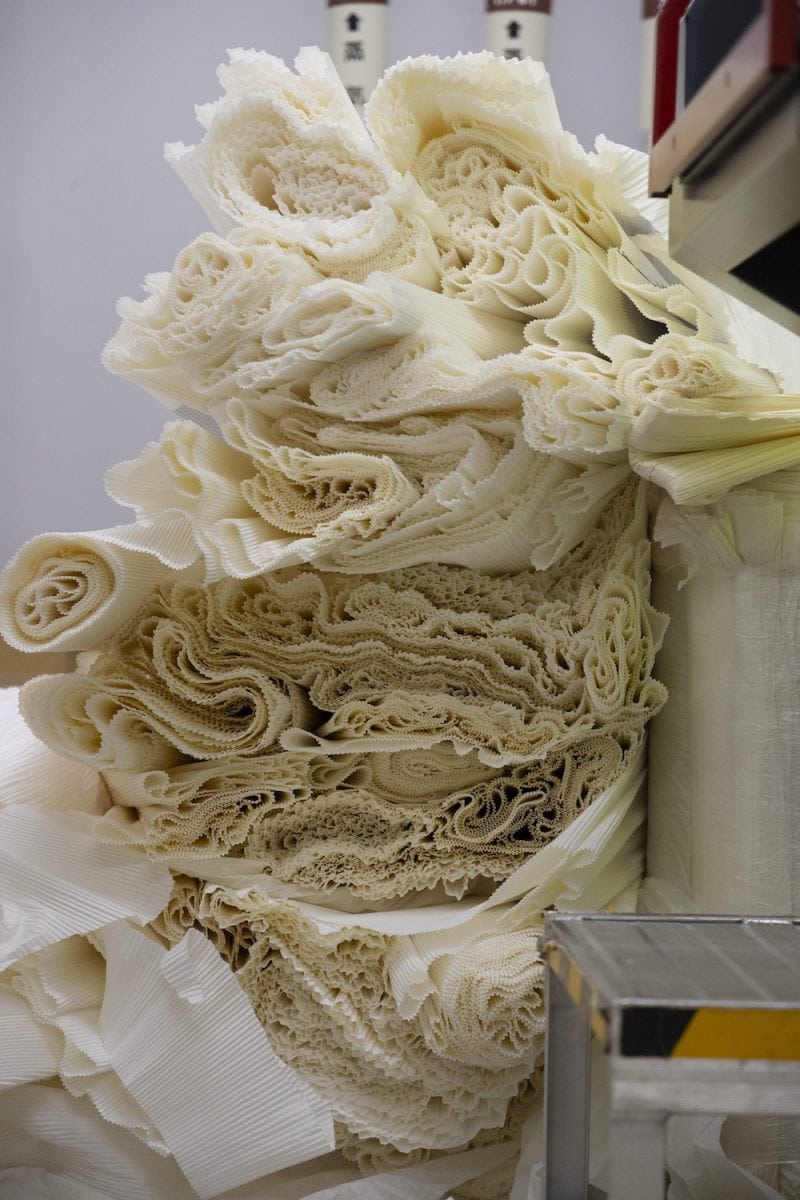
AK: And I wanted to give this question to everyone, but the concept of memory is so incredible in this project, from the preservation of the colors of the garments, through the lines of the log, and the tree. What does it mean to preserve memory in this way for all of you?
SK: I think in memory, there are two levels. There’s this technical or conceptual one. For us, looking at the log, we can imagine what was going on that day at a factory, what color was being pleated, and we can imagine what type of garments were being made. It tells a lot, just in the cross section or marbling.
There’s a lot of story, and it also represents how the garment pleating was performed, and beyond that, the philosophy of Miyake and our company. So there’s all this kind of association with a simple log, and I think it really provides a lot of hints of what we could change, just by looking at it.
DM: For us, we usually try to keep as much of what the materials come with. And in this case, the pleat is a clear representation of this memory, that it was part of a garment at some point. And it’s beautiful.
So we really like the imprints of the process of the lives of the materials. We think that they bring quite the texture and richness that we need, whatever we work with.
AG: Neurologically speaking, there’s a short and a long memory. We talk about short memory: the material reacts because of how it was built. So it’s literally a physical thing. Also, we talk about long memory, and we started with this La Santa Teresa de Bernini. This history of sculpting, of capturing the expression of an instant, has been a long desire of art.
There’s always this idea of capturing time with art. It’s always about a spark, about an insight. So, I think this is also the memory of this object, just let them flow naturally, and freeze it. That was in seconds. Later, there were many hours of craft, and many years of practice, to arrive to these conclusions, to have creativity is an instant, the rest is just hard work.
But you need ten, twenty, years of life, to arrive to that moment of that instantaneous creativity. So this is the long memory. The long memory is also very important. There’s a long memory in the legacy. It’s been working through this idea with different collections. Every six months, that memory is refreshed. But the long memory is the same.
SK: Doing Milan Design Week creates a new visual understanding to really invite children, invite students, invite creative people from different disciplines to really join and have conversations.
I think what this project is about, which is only the beginning, is to inspire us, to really serve as a seed, to grow a lot of conversations, and to invite different perspectives, to look at the same logs. We have our own perspective. They have provided their perspective. And I think there’s still more different viewpoints to this same paper log.