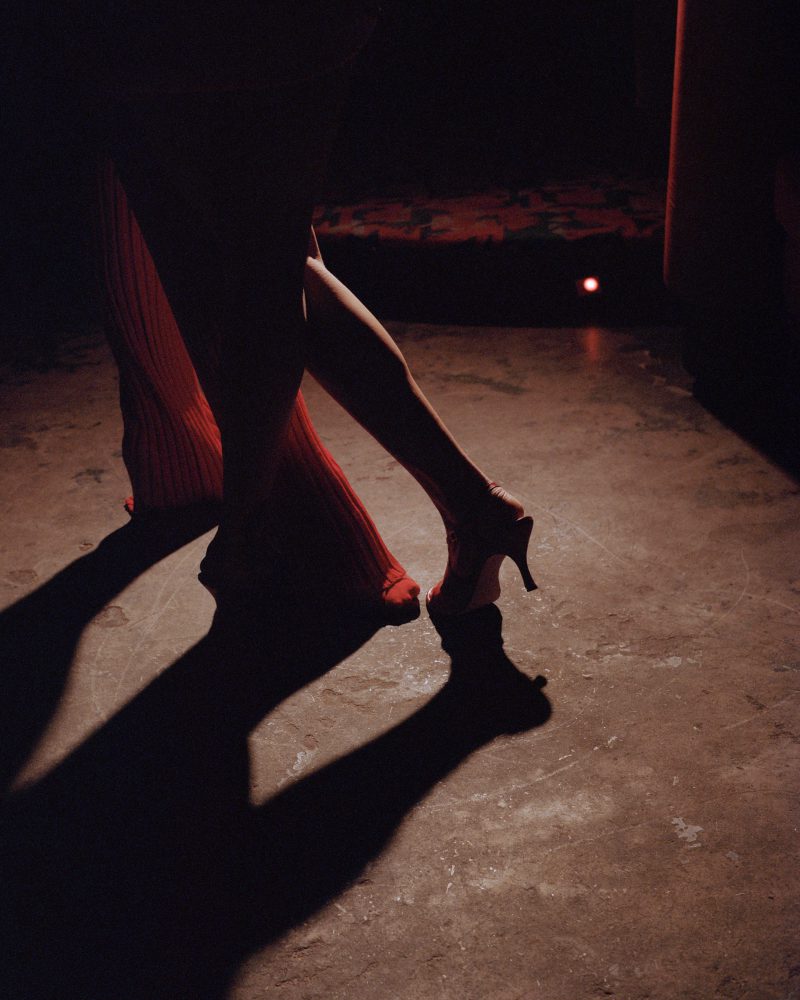
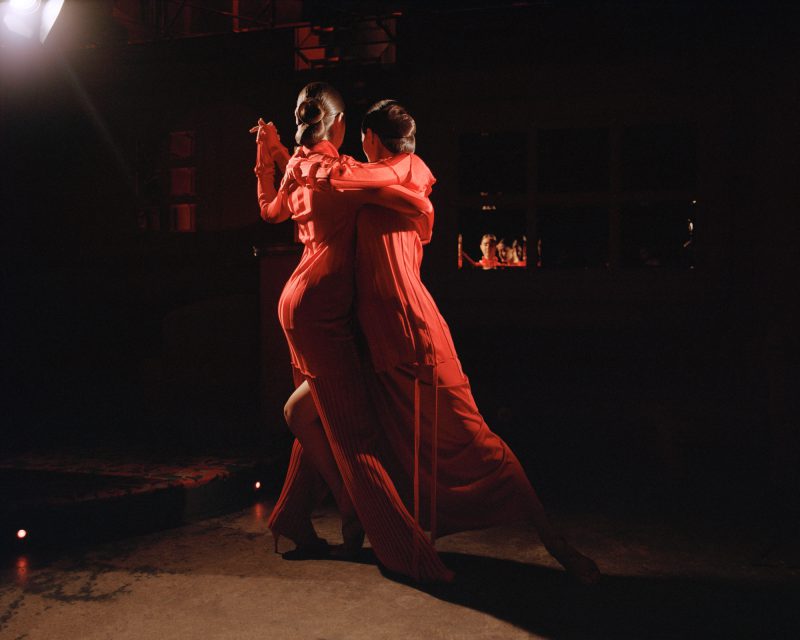
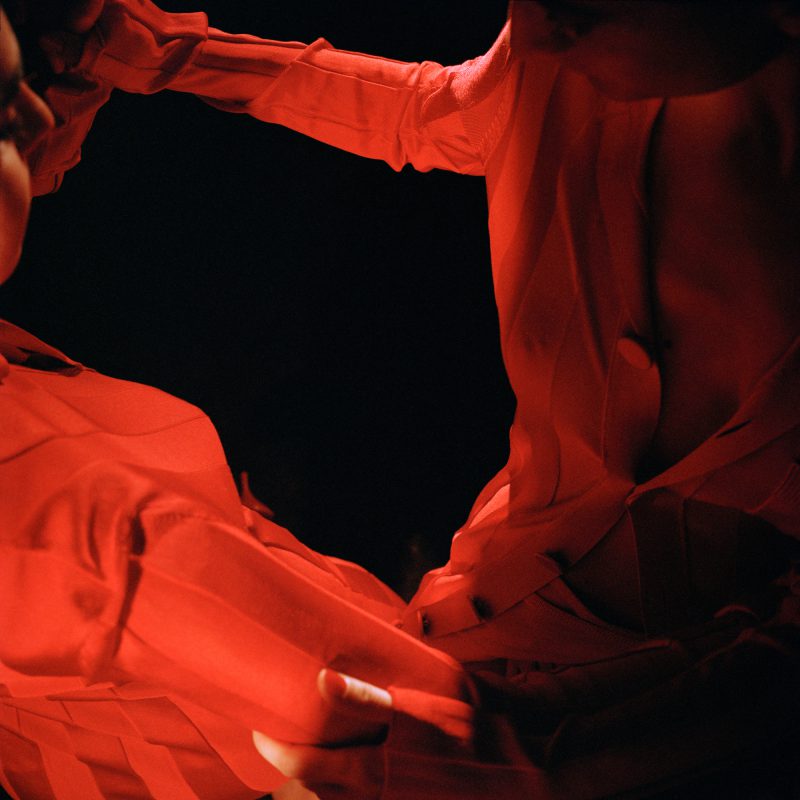
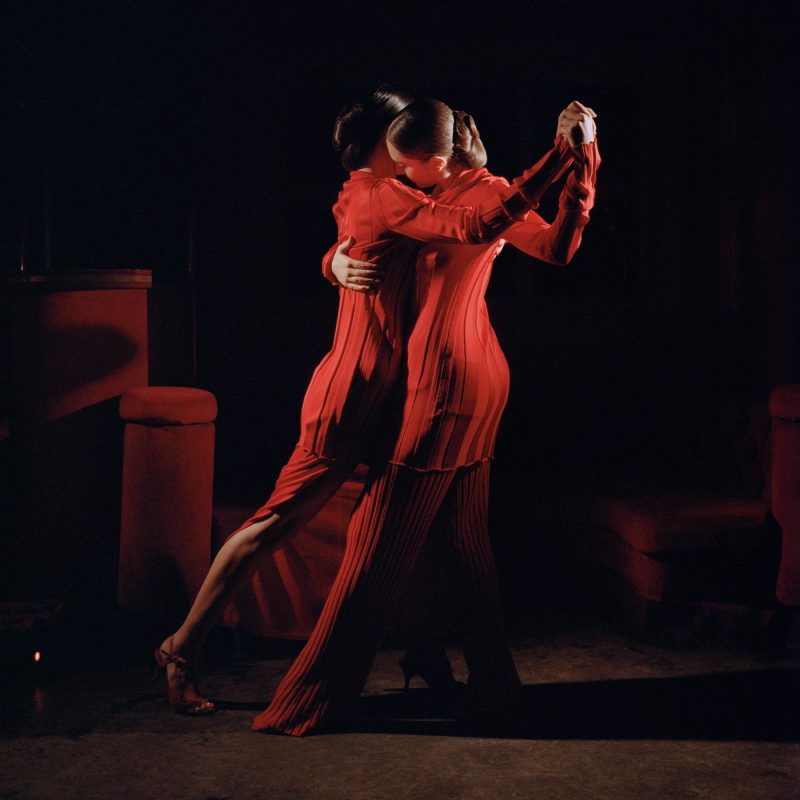
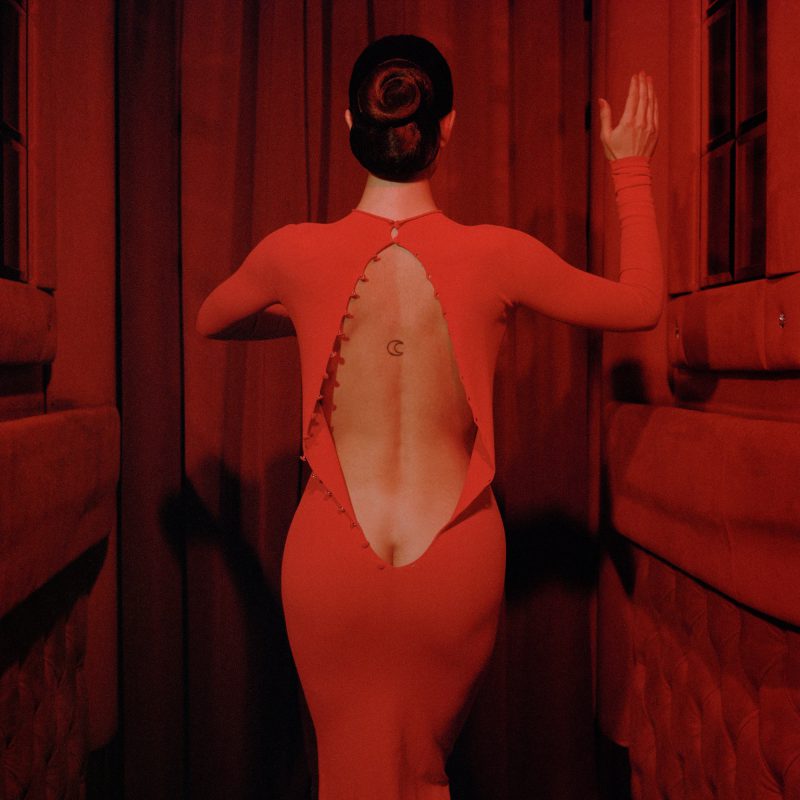
In tango, even before the steps, there is an unspoken agreement: two bodies establish how much space to allow one another. Drawing closer means, at the same time, exposing oneself and offering resistance, trusting the other without ever looking away. “Por Mi Tango” draws on this tension, born from a concept deeply tied to Giuditta Vettese’s passion for tango and brought to life through her art direction alongside the team. The visual project strips the dance of its most recognisable imagery to focus on what remains when the music seems to have faded away. In Alessandro Merlo’s images, red does not merely accompany the scene: it envelops it entirely. Upholstered walls, curtains, clothes and skin merge into a single chromatic substance, transforming the space into a sort of inner chamber. The parallel with the use of colour in Pedro Almodóvar’s films is immediate, where red can simultaneously embody desire, danger and theatricality.
Here, however, the saturation takes on an almost claustrophobic quality: there is no real escape from the scene, only bodies that emerge and fade into the shadows. The tango is thus broken down into its constituent parts. One leg crosses over the other, a hand rests on a hip, two figures draw closer until they become almost mirror images of one another. In one of the shots, a face painted white abruptly interrupts the sensuality of the sequence, introducing a disturbing element, reminiscent of a mask and the theatrical realm. In another, a solitary body assumes the posture of the dance without a partner: the gesture survives the encounter. It is perhaps here that “Por Mi Tango” reveals its most evocative image. Desire is not depicted as a linear path towards the other, but rather as a circular motion that constantly returns to the one who feels it.
The two dancers may be lovers, adversaries, or reflections of the same figure. When they finally embrace, the embrace does not resolve this ambiguity: it amplifies it. ROT’s costumes also form part of the choreography. Cuts, back openings, form-fitting fabrics and vertical pleats follow the body without making it entirely accessible to the gaze. Fashion thus becomes an integral part of the movement, a surface that both reveals and conceals. Rather than narrating the tango, “Por Mi Tango” captures its essence: that minimal, unstable distance that separates desiring someone from desiring to be desired.