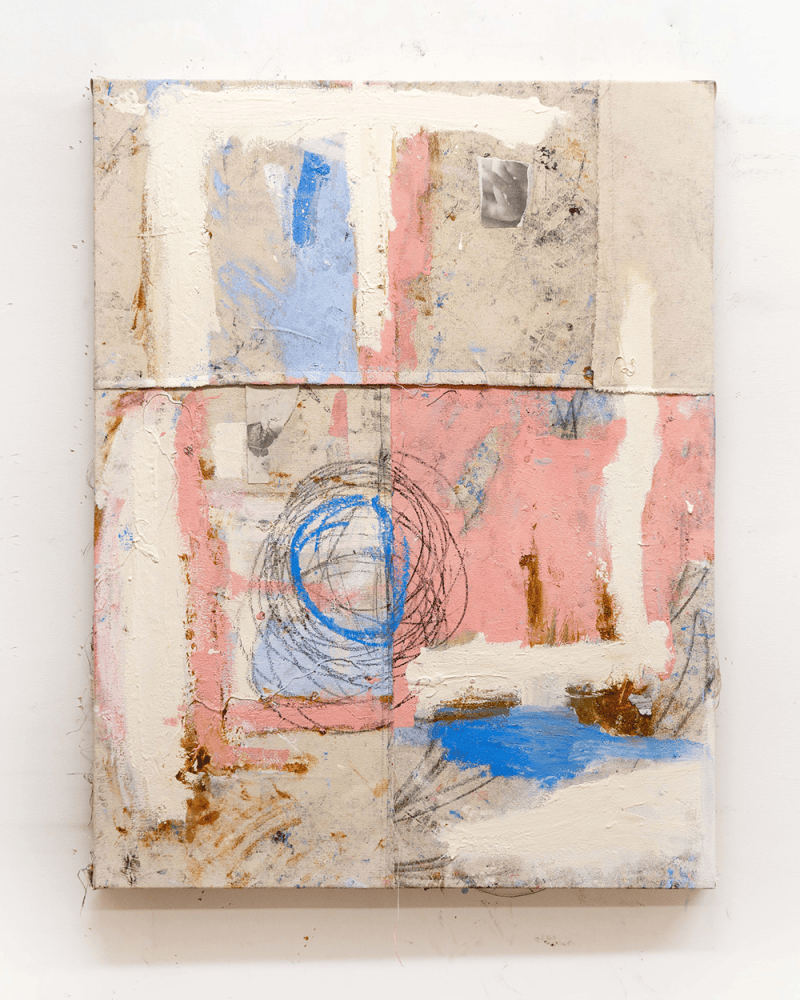
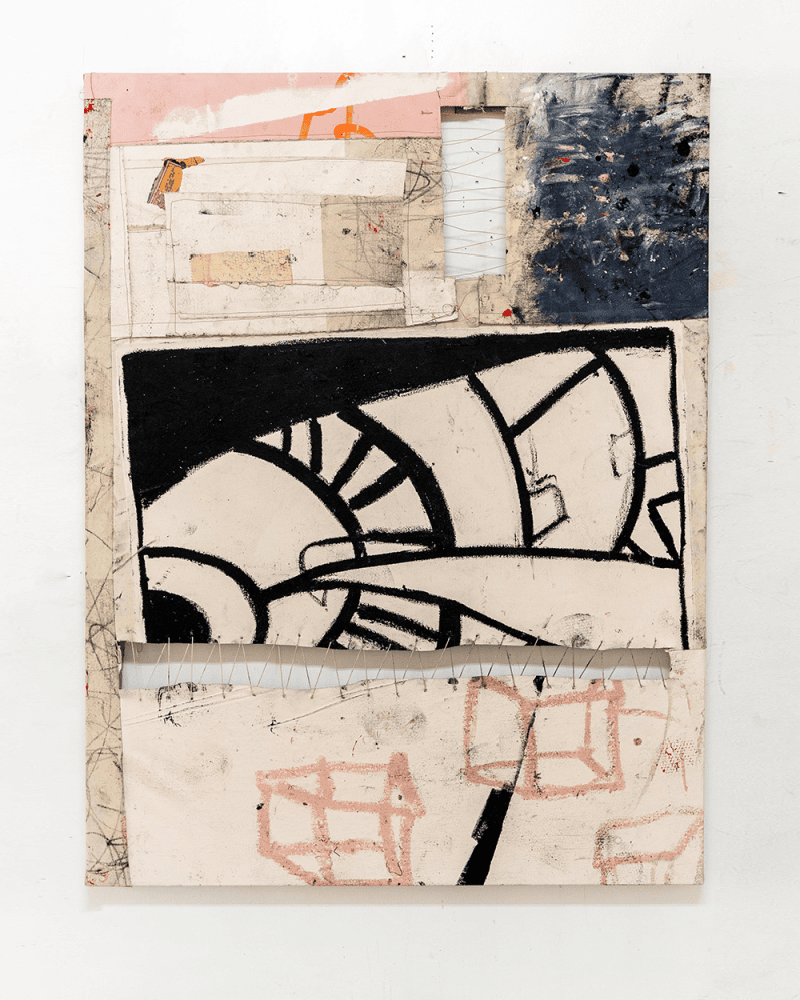
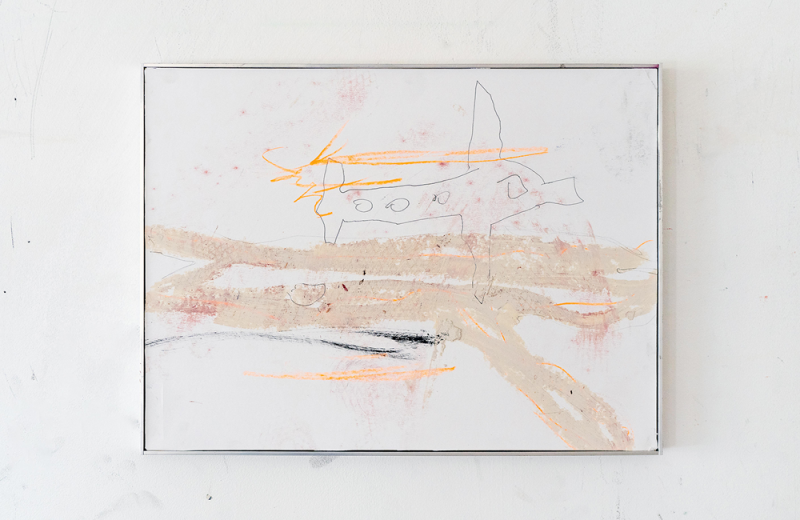
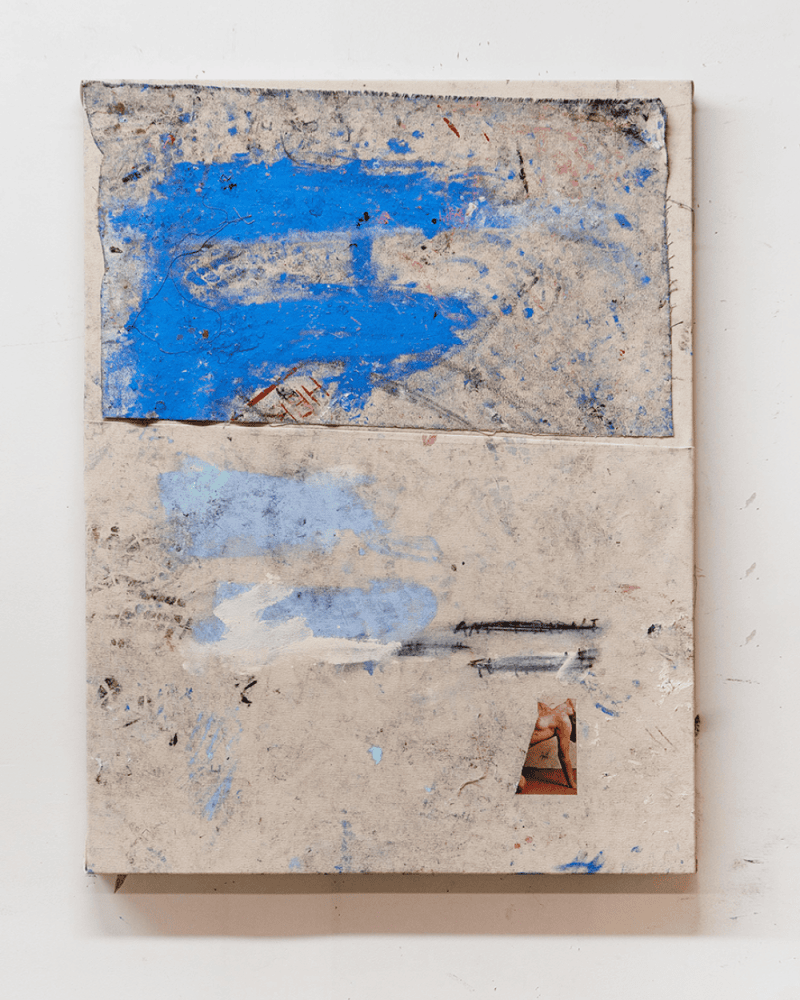
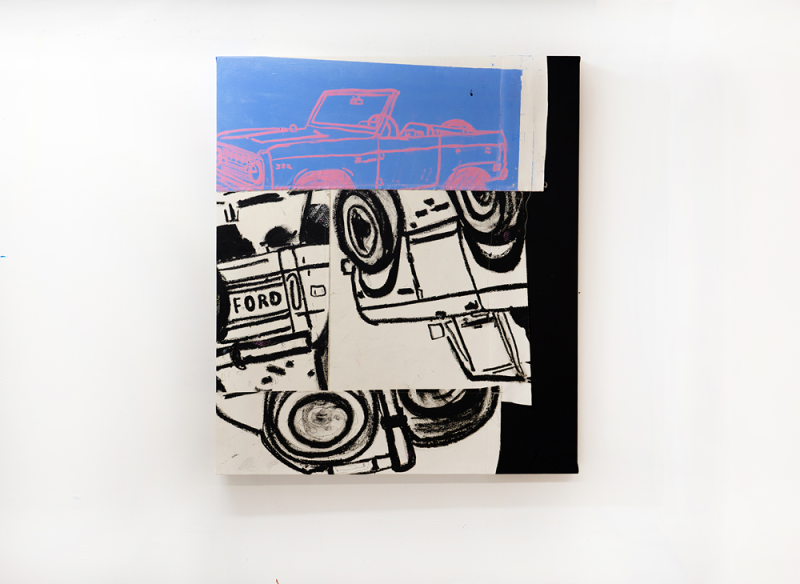
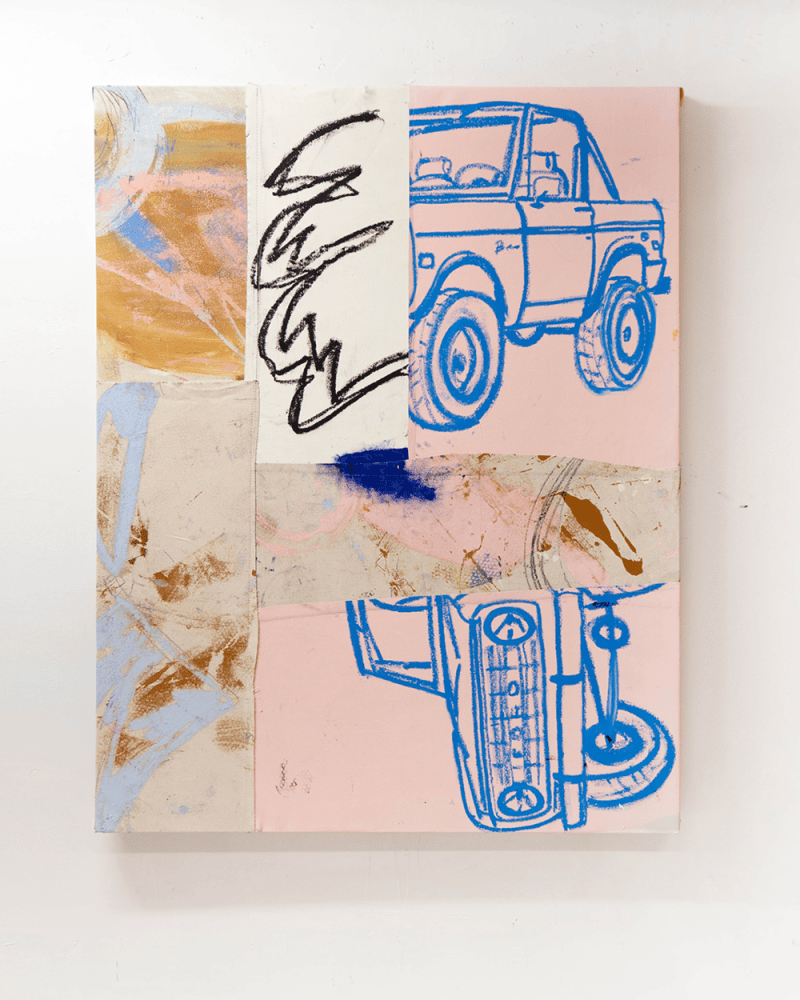
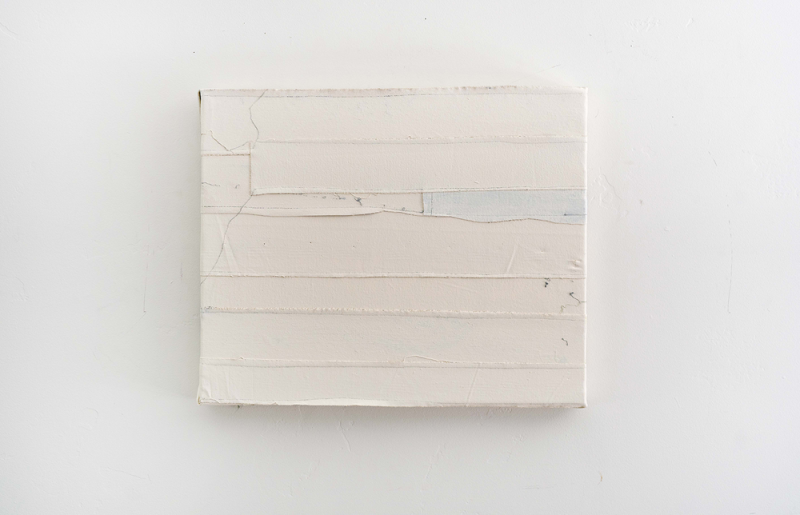
These canvases do not tell a complete story from beginning to end. Instead, they show fragments: a cropped figure, the outline of an off-road vehicle, lines that are interrupted or repeated. In Merritt Spangler’s paintings, the image is an open field, where each element can take on a different meaning depending on the elements around it. The material itself contributes to the composition. The surfaces are worn, layered, marked by stitches and irregular edges; colour is applied in layers, without completely removing the previous ones. In the first work, pink and blue combine with dark traces and photographic fragments, whilst a circle drawn repeatedly remains visible, caught between drawing and erasure. Elsewhere, large black and white shapes occupy the canvas as graphic elements: they evoke a wheel, a sign or a detail magnified to the point of abstraction. There is no single interpretation. Even the cars drawn in blue and black draw on a shared imagery, yet are stripped of their usual function.
They are depicted in fragments, upside down or divided into panels: everyday objects transformed into unstable forms. Alongside these, rapid strokes and more delicate areas disrupt the structure, as if the composition were the result of a chance encounter and had been left incomplete. This spontaneity does not imply randomness. Spangler uses error and imperfection as elements of the process: she does not correct every variation, but retains it. The result retains a physical and immediate quality, akin to a note or a memory that emerges without any precise order. This exploratory aspect concerns not only what takes place outside the studio, but also the way in which an image takes shape, changes and resists a single definition. In *Painting*, ambiguity is not something to be clarified. It is the space within which the gaze can move: between what it recognises and what remains undefined, between the attempt to attribute meaning and the absence of a single meaning.