
To inhabit the day after, waking up with a feeling of unease. It is unclear where it comes from—perhaps from this whistle that has been piercing our ears for some time now. But its sound is too murky, its memories are gone, they slowly fade. To plunge into urban patterns, getting over the awakening. To stand beneath buildings, between exit lines. There is something unresolved about these structures. A shiver that makes them tremble, yet does not compromise their stability. No sign of collapse. We expect from the day after to reveal the wounds of yesterday: broken glass, torn-down gates, some say chairs were thrown. All due respect to a few trickles of blood quickly washed away. But how did they manage to clean everything up before we came back to these streets? How meticulously did they stitch up the scars of these sidewalks? No conflict is detectable if you look at the volumes of this place. Shall we treat our tinnitus?
I suspect that Lorenzo Schetter Li Greci (Naples, 1999) relies on this whistling reverb of the day after and lets it guide his steps. He wakes up with a feeling of unease, he perhaps forgets about its cause, but he insists on tracing its signs outside.
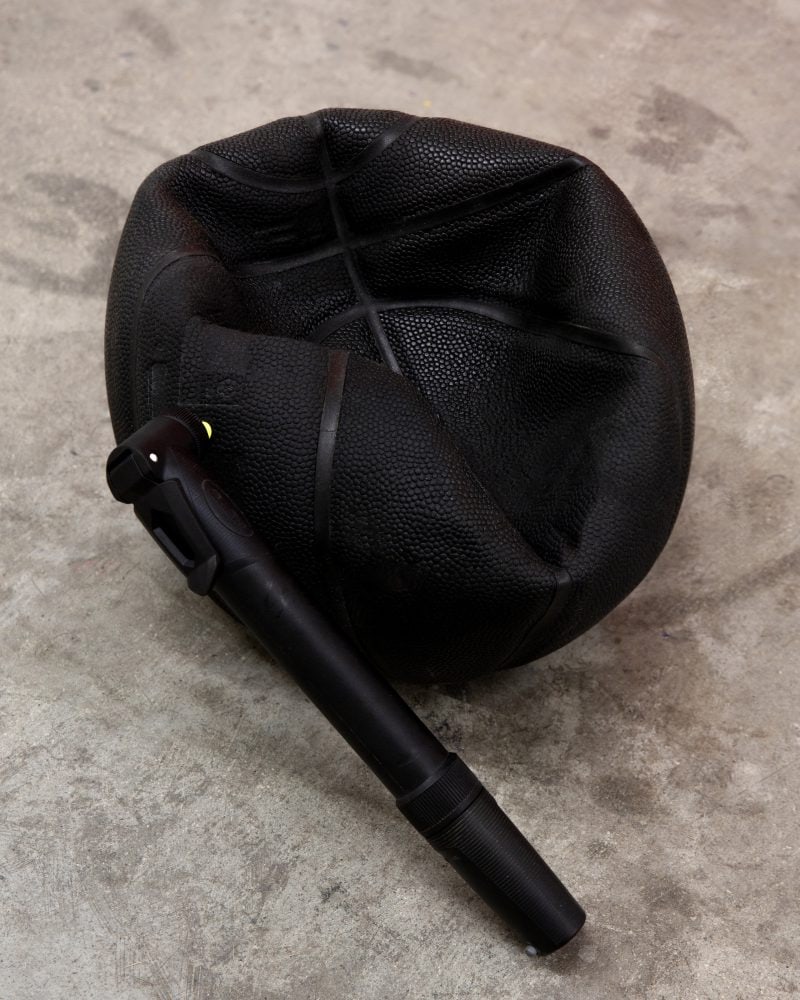
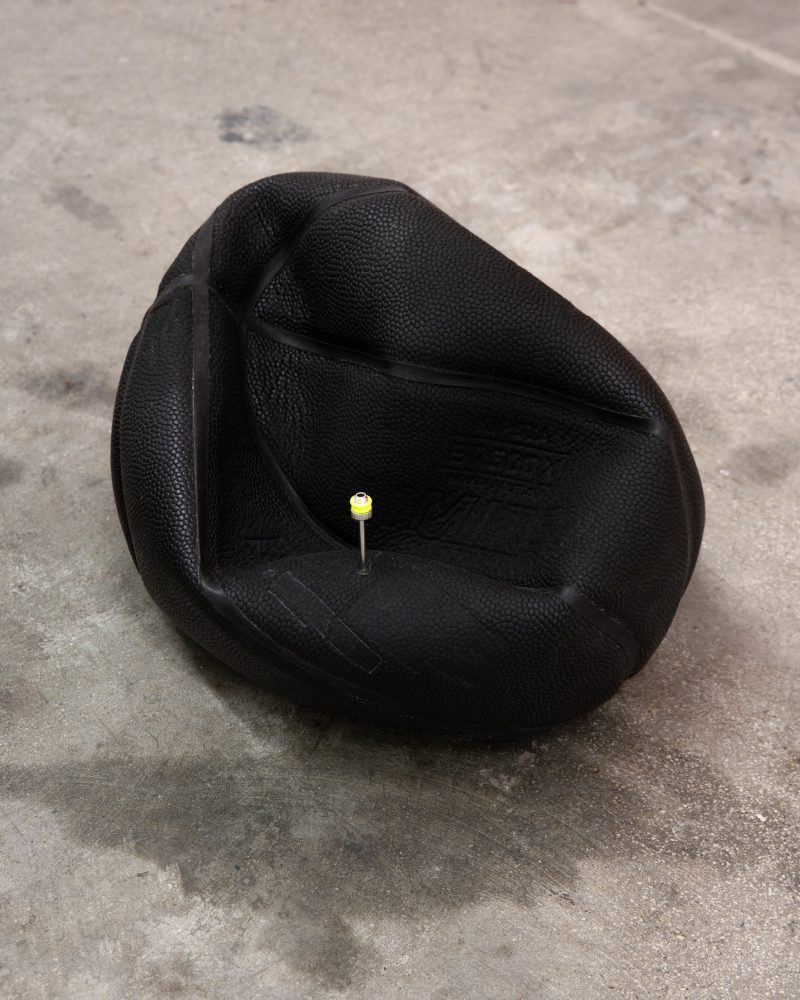
The memory of a reverb makes him exit his house, Out for a walk (2025), and stumble upon two deflated basketballs painted black. The pulsating buzz of the bounce has stopped. A few lazy vibrations are maybe kept on the withered surface of the rubber. But rubber is not a great conductor of sound. One of the balls is punctured by a pin, the other is attached to a pump. Two contrasting and identical perspectives: the hope of being inflated and (re)acquiring a sphere-like plumpness, and the disappointment of deflation. If both tools were to penetrate a single balloon, the artwork would be a plain metaphor for disenchantment, for the hissing elapse of time wasted on a useless exercise leading to its own fiasco. However, the artist chose to present two of them, almost as if they were two polarities of a conflict that he cannot name. Or rather, that he cannot define unequivocally, having such shifting configurations and operating on diverse scales. Failure and resistance are hence presented as fundamentals, as stages within a (onto)logical movement that spans between abstraction and re-embodiment in daily objects, thus returning to its earthly matrix. The ground absorbed their buzzing bounce over time, along with the screech of sneakers, cheesy dreams of success, consolations, disappointments of making it second or not making it at all. But now they’re all hush, and rubber can’t keep reverb.
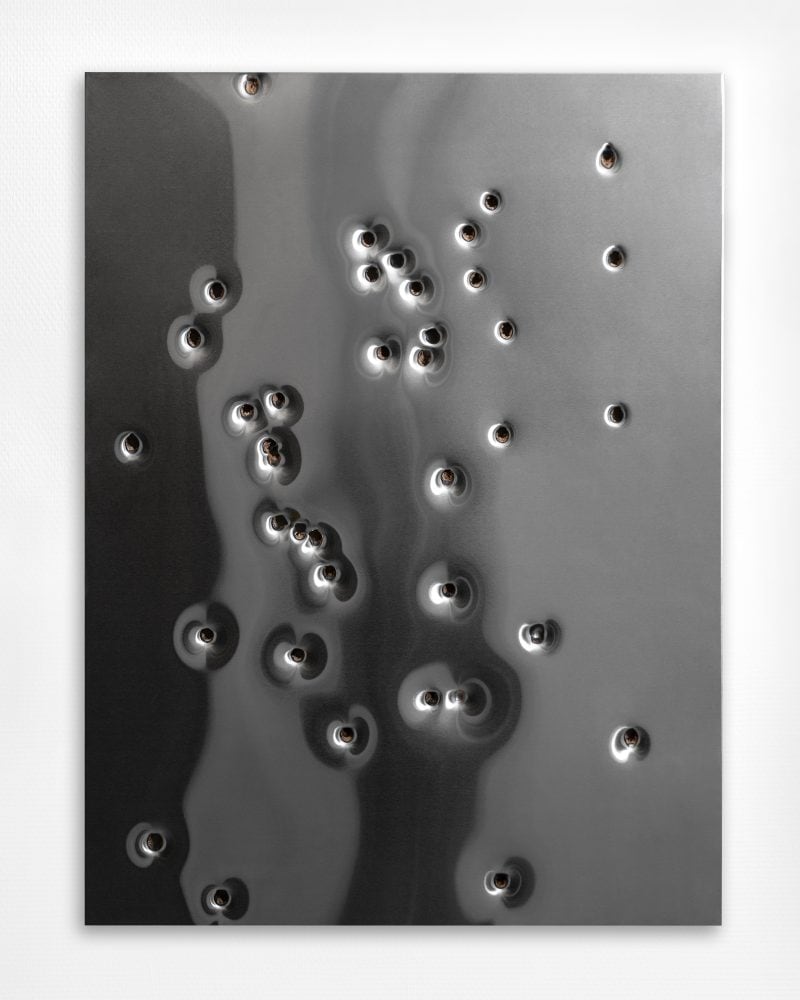
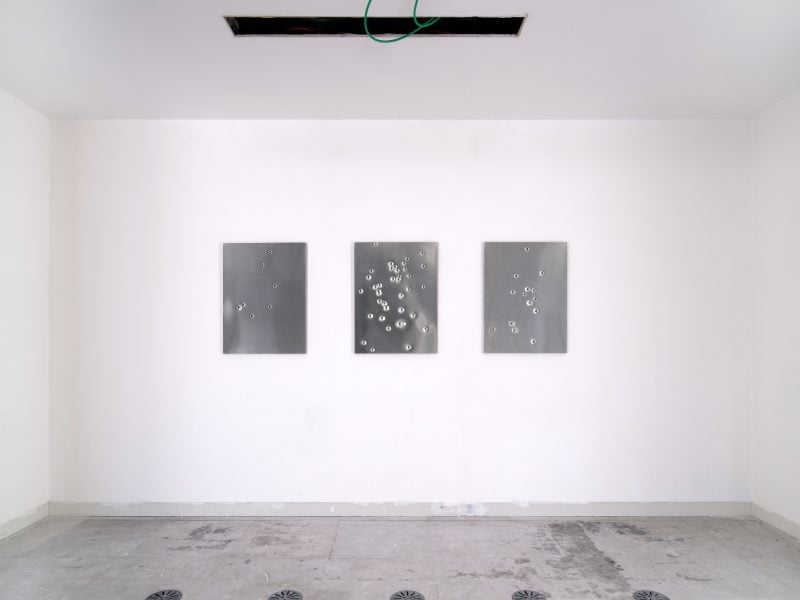
Metal, instead, is an excellent conductor of sound, The sound of your skin (2024) vibrates on iron plates. Lorenzo talks to me about this piece describing it as a meditation in three times, whose tempo is dictated by bursts of semi-automatic guns. More than the subversive violence of the gunshots, more than the complacency in the furious use of firearms, more than the formalism of the operation, it is the emotional metaphor that creates a disturbing friction. The recipient referred to in the title seems to resemble the open “you” of lyrical poetry, defined by nothing more than an opaque relational dynamic. The cold, inert surface of the work is elliptically associated with a virtual extension of the skin, exposed in its fragility. A permeable surface, the perforated skin of things, covers not only bodies, but an entire vulnerable ecosystem. It does not aim to protect them, but to make them visible in their fallibility. Perhaps that is the reason why Schetter Li Greci takes the bodies out of thescene, freeing them from any system of visibility and allowing them to deceive any logic of sensationalism surrounding narrations of conflict. The artwork doesn’t center bodies, there is no culprit to identify, no justification to claim or condemn. The dimension in which he works is pre- or post-performative. It concerns an action that is not immediately visible, and which is perhaps forgettable, just as the cause of the feeling of unease is forgettable. The investigative reconstruction of the event—the public exposure and martyrdom of the three steel panels—leaves time as it finds it, and the shock does not survive a second glance. What remains are the distortions of the reflective surfaces of the plates, disturbed by a constellation of sixty blind holes. The irregular protrusions of the coated surface do not yearn for a real or presumed original compactness, nor do they seek to block the hand of the sniper. Rather, they bear witness to a fracture that conditions politics, affections, and bourgeois life—similar metal alloys are used in high range kitchens.
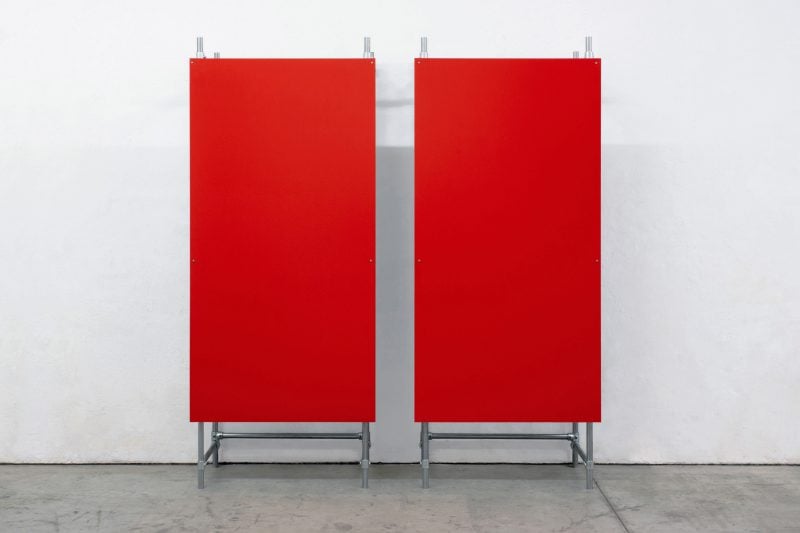
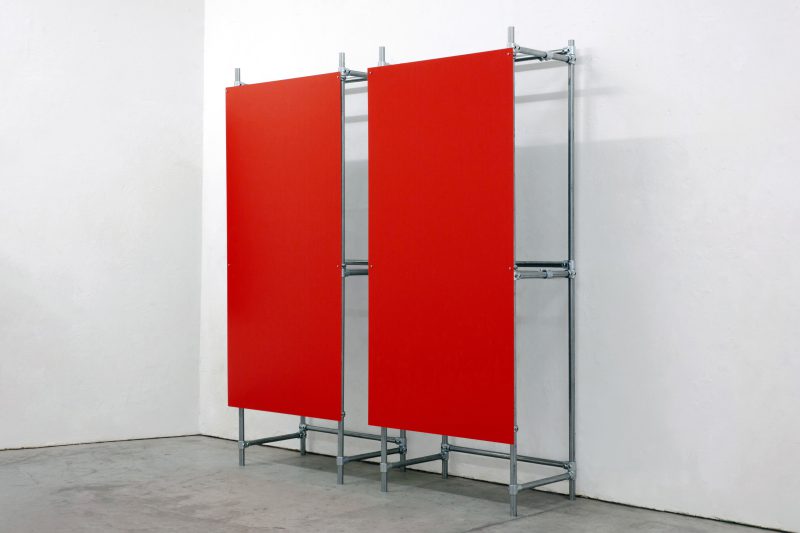
There is a formal cleanliness in the artist’s works that echoes the stasis of metropolitan spaces the day after the turmoil. The ambiguous silence of peace. But metal is an excellent conductor of sound, and it still vibrates when insurgency has fallen silent. Scaffolding tubes channel this vibration, In memory of The Red Ballad (2025). A given distance, physical or symbolic, and a subtle, persisting sound. The scaffolding here has no productive purpose, nothing is being built. Schetter Li Greci analyzes the visual codes of urban landscapes and manipulates them to build a containment structure. He maintains its glossy patina to investigate tropes of capitulation. Two heavy steel panels painted with luxury industrial enamels create a smooth barricade. Behind the seductive balance of shapes and geometries, the artwork actually defines a ban on the viewers’ bodies: no trespassing, climbing over or breaking down is foreseen. The structure’s restrictions only allow the viewer to be a spectator, and to dive in the chromatic quality of the plates: a RAL color patented by the artist and flamboyantly named Lorenzaccio. We can imagine this dense red tone to be the last dispatch of the ballad evoked by the title. We can further imagine that this ballad could have been narrative and folkloristic like medieval lay, precious and melodramatic like romantic compositions, coated and affectatious like American songs, or pulsional like a free party. The lines of flight inspired by the late ballad have been brought back into order, formally structured in a way that is compatible with the normative layout of the city.
Verbal language has been lost over time; but a subtle vibration, a sense of nemesis survives in symbolic language. The hostile architecture of the two panels resounds with the failure of every attempt at resolution, surrender, and pacification.
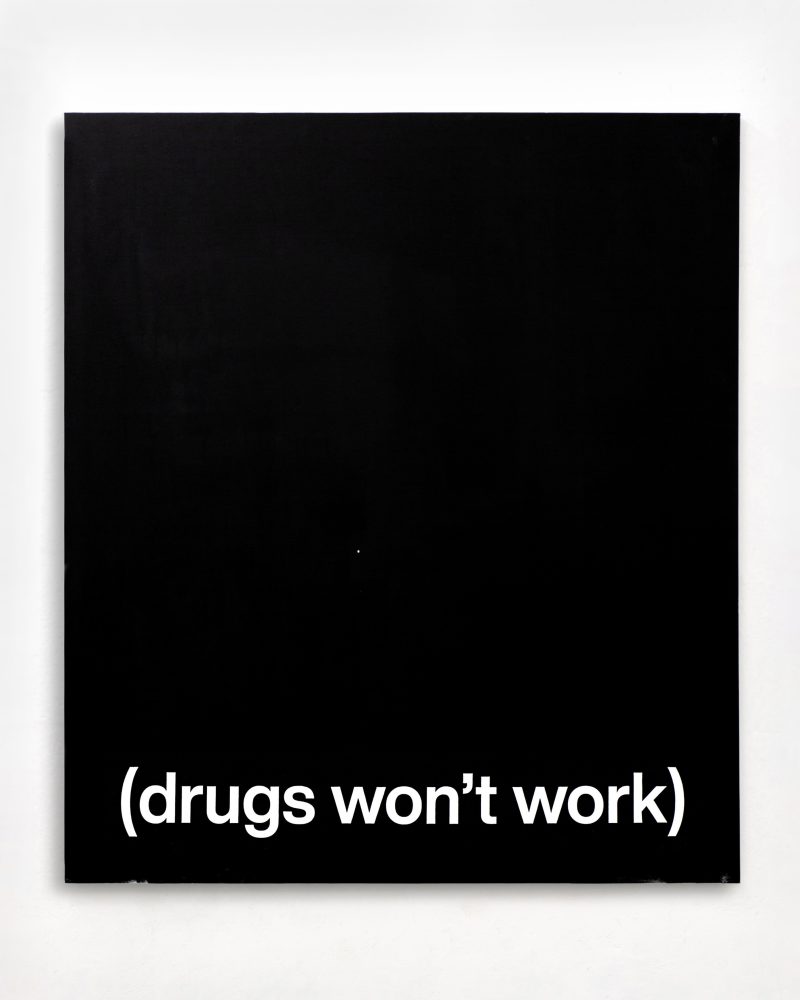
Verbal language has been lost over time, but sometimes it emerges, jaded, from dense expanses of color. Drugs won’t work (2025) makes its way, lowercase and in parenthesis, in pasty swaths of dull black. Here, the word is not assertive: it reneges, rejecting itself on a syntactic and typographical level. It steps aside, choosing to weaken itself. It lacks the power of a slogan, and refuses to occupy a central position on the canvas. Instead, it takes the form of a memento, a warning to be suspicious of any solution presented as ultimate. Schetter Li Greci works by subtraction, using the empty spaces of omission to give breathing room to diaphragms of reflection and potential action.
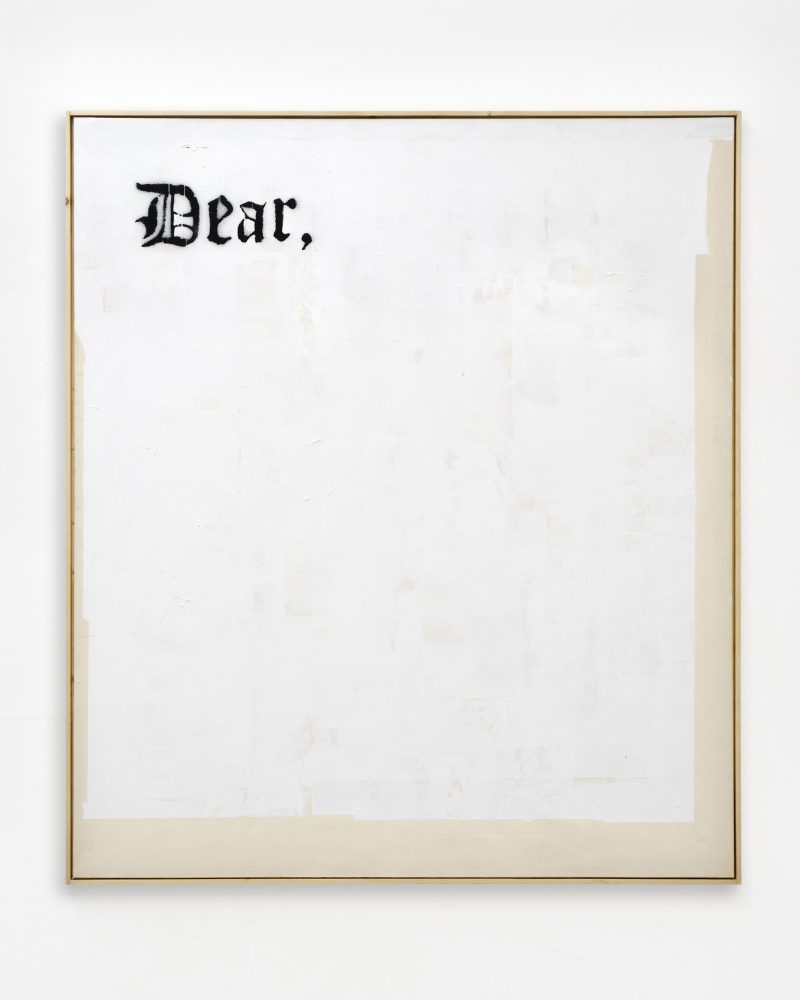
Preparing the perfect response (2025) in a conversation that looks more like a duel. A canvas that is not entirely bleached, a letter left unfinished. For now, it only remains an intimate salutation, Dear… It seems like the artist wants to take his time, not only in the formal execution of the work—the immediacy of graffiti and spray paint being entangled in the labyrinths of a Gothic outmoded lettering—but also in the mental organization of language. If other artworks dealt with the aftermaths, with a post-performative dimension, with the effects or responses that the event provoked, here one swims in the whiteness of the before, in a network of virtual developments projected onto an empty surface. We could imagine a mental block, a reticence, an obstacle that obstructs the flow of words and condemns to silence. Or a strategy, a positioning, a measurement of the opaque magma of reverberation before any grammatical order arrives to give a form to it. The artwork on its own could hardly bear this emptiness, it gets lost in the white. It conveys now a hectic relationship with bodies. Schetter Li Greci previously removed the bodies from the frame, shielding them from representative visibility and manipulation. But somehow the artwork summons them, and he lets them buzz behind the scenes.
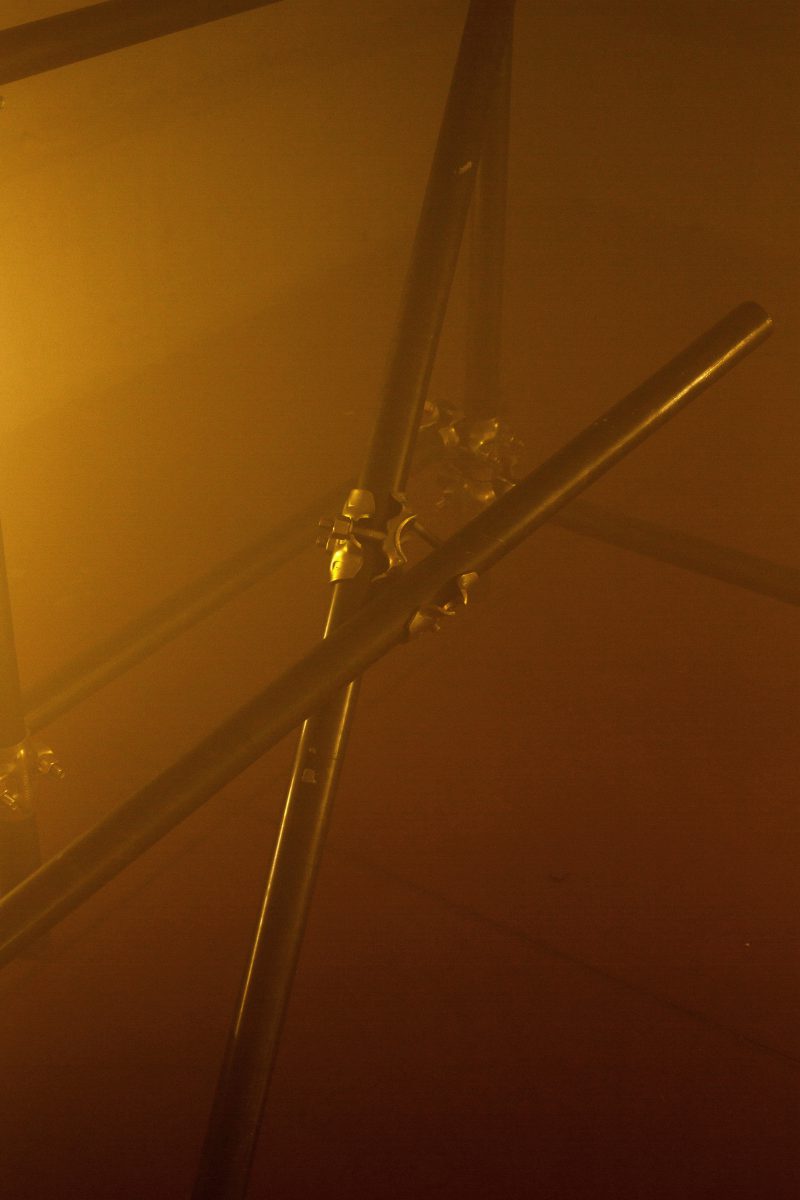
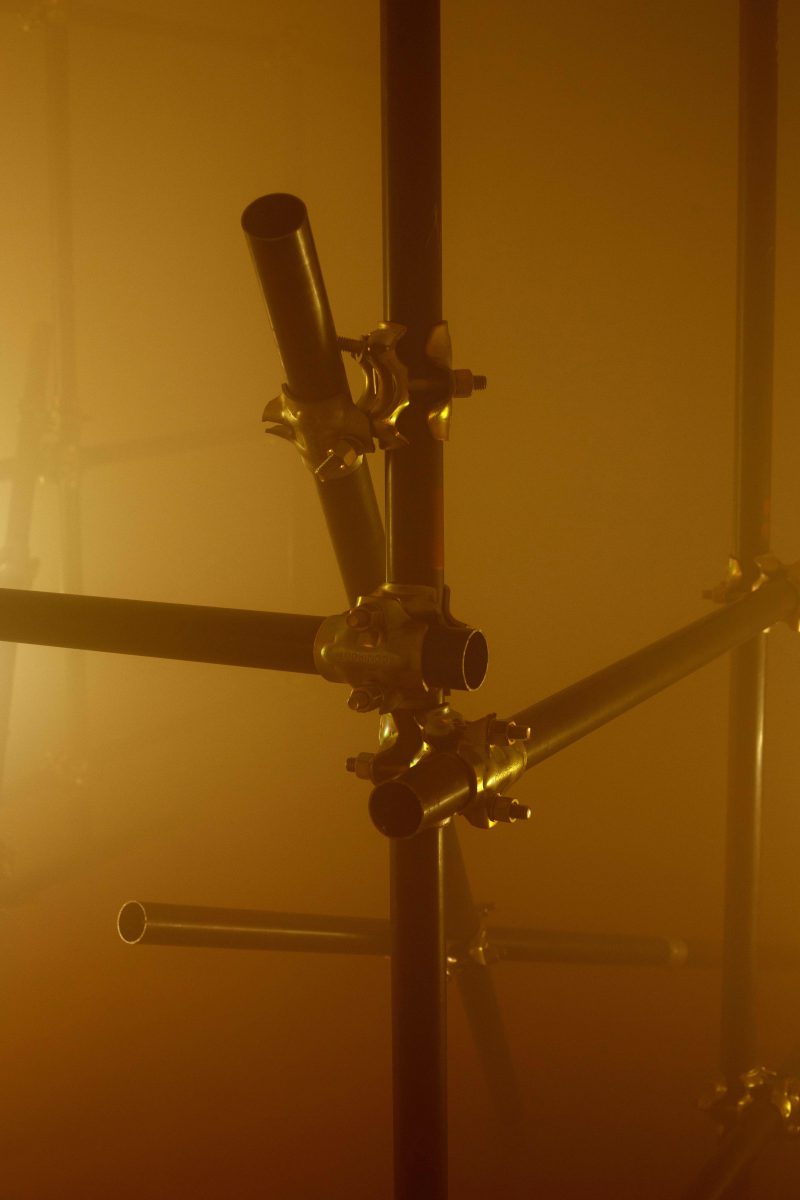
The theater is destroyed but (…) the bad dogs are still lurking around it (2025). There are no ruins in this destruction. The structure remains solid, the beams are level, the angles are surgical. One expects the theater to bear the wounds of the day before (of the assault): broken glass, torn-down gates, some speak of flames. The voices are lost in reverberation. Nothing compromises its stability, there are no signs of collapse. The structure is solid, but it is stripped bare. An architecture of innocent pipes is the abstract image of a real space, free from cumbersome volumes and too many connotations. The space no longer has prescribed uses; quadrupeds can cross it as they see fit. The work is presented in the context of a party: free bodies cling to the ribs of this architecture, climbing, crawling through the openings in its mesh, trying to force its stability. But a sense of nemesis persists, the metal still vibrates with conflict. No reinterpretation of space can ever be definitive: there is always an adversary lurking, ready to contradict it.
But there is always a range of voices before and after the last word. And a steel skeleton.
To inhabit the day before, falling asleep with a feeling of unease. To wake up the day after, walking with a feeling of unease. Recognizing it, forgetting it, chasing it, failing it. Dogs dance.
[As I write these lines, I realize that conflicts can be named. As I write these lines, I reconsider narratological visions of the enemy. There is no confusion with aggressors and culprits. I do not indulge in nemesis, I refuse its romantism, anger arises. A feeling of unease persists—the only thing that remains murky]
Lorenzo Schetter Li Greci (Naples, 1999) is a visual artist working across painting, installation, artist books, and experimental sound projects. His practice investigates memory, traces of violence, and the tensions embedded in objects, space, and perception. He lives and works in Milan, Italy.