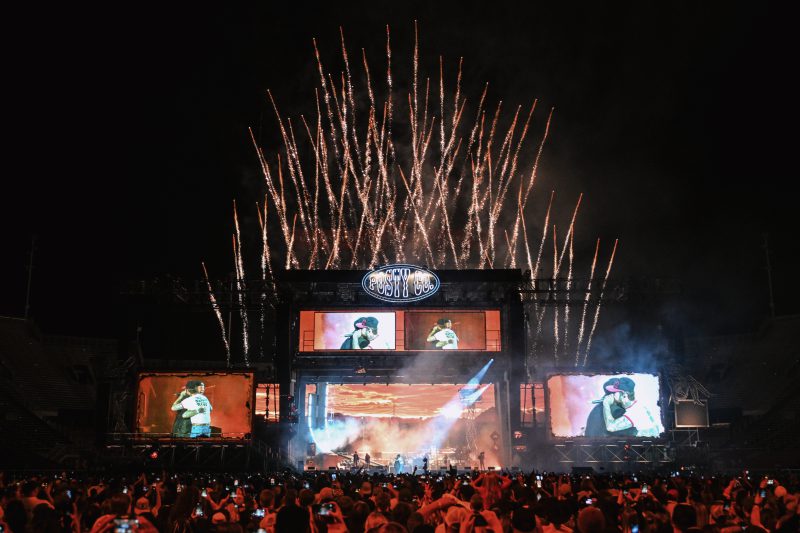
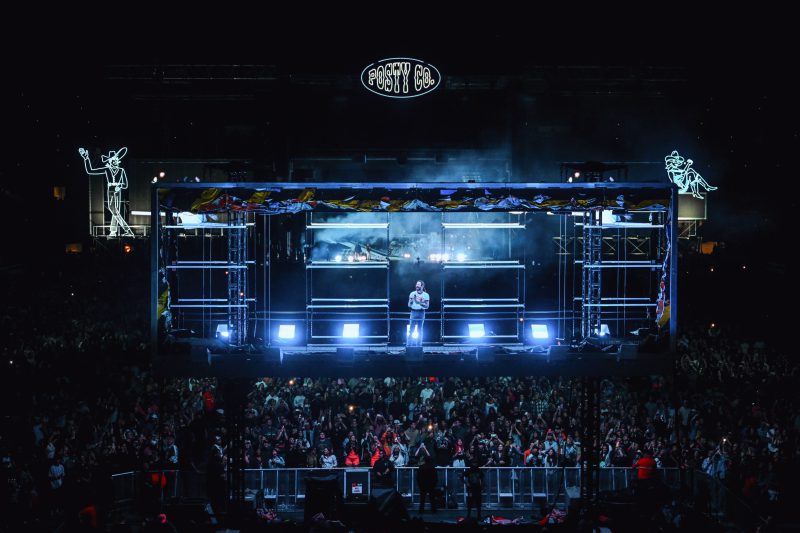
There’s something deeply cinematic about turning a stadium into an American road, where nostalgia and myth collide with the contemporary energy of an artist like Post Malone. With the Big Ass Stadium Tour, STUFISH Entertainment Architects reimagines the language of live performance on a monumental scale, blending the aesthetics of roadside Americana with the symbolic power of the journey: a stage design that is at once landscape, narrative, and a mirror of the artist’s identity. In this conversation, the studio reveals how they crafted an experience that fuses spectacle and intimacy, technology and theatricality, building a stage that feels like home, highway, and collective dream all at once.
Here you will find Ritamorena Zotti’s interview with STUFISH’s Rachel Duncan, who was the Senior Designer on the tour.
RITAMORENA ZOTTI: The Big Ass Stadium Tour presents a cinematic vision of roadside Americana. What drew you to this imagery as the conceptual backbone for Post Malone’s stage design?
RACHEL DUNCAN: The concept for the show was brought to us by creative director Dannah Gottlieb, following a discussion with Post Malone. We worked together, along with lighting designer Rob Sinclair, to develop this idea further. The road serves as a framework to illustrate the artist’s journey throughout his career. Conceptually, the road represents the different choices he has encountered throughout his career, as well as the friends he has met along the way. It feels especially fitting for an artist who has moved with agility across different genres in his work. That’s partly why the idea of ‘Roadside America’ felt right. He was born in the United States and now lives just outside of Utah, so the theme naturally connects to his story. We had so much fun incorporating some of the conceptual elements of roadside Americana at STUFISH. We’re really fortunate to have an amazing library of resources. We collected a lot of material on roadside Americana, which includes quirky landmarks like the world’s largest tile or the world’s largest belt buckle. It felt fitting to frame the tour around roadside Americana and it gave us a great opportunity to play with the design and create a variety of elements that supported the story and it even invites audiences to engage more directly with these roadside objects.
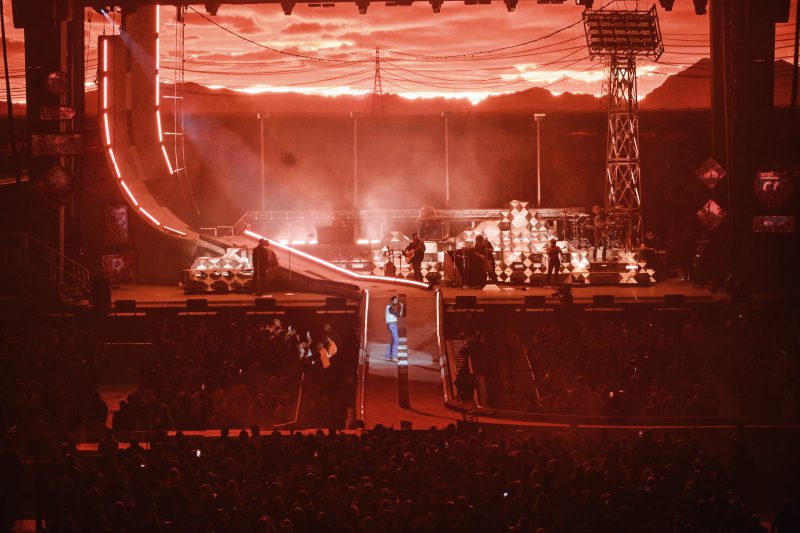
RZ: The winding road that cuts through the crowd and splits at a crossroads is both theatrical and symbolic. How did you approach balancing metaphor with functionality in this central element?
RD: We were very fortunate, because as an artist, it’s really important to him that he can reach as many people in the audience as possible. That naturally meant creating a design that covered a lot of ground and reached a lot of different areas, which aligned perfectly with the idea of the road. In the Coachella show, the road needed to carry him far enough out into the crowd to reach the Billboard. That’s why the road stretched so long in that performance, it balanced the symbolic with the functional.
RZ: Scale plays a huge role in this show, from towering pylons to the hidden 50-foot billboard. What is your process when working with monumental proportions without overwhelming the performer?
RD: As the name suggests, “The Big Ass Stadium” tour invited us to push the boundaries of a live stadium show, which was exciting. As a studio, we always make sure that everything we design has a purpose and supports the artist rather than upstaging them. The pylon, for instance, wasn’t just scenic, it was one of the main lighting sources for Rob Sinclair to light the band and the artist. At the start of the show, a spark travels along a wire across the stage and culminates in the pylon, which creates a really striking moment.
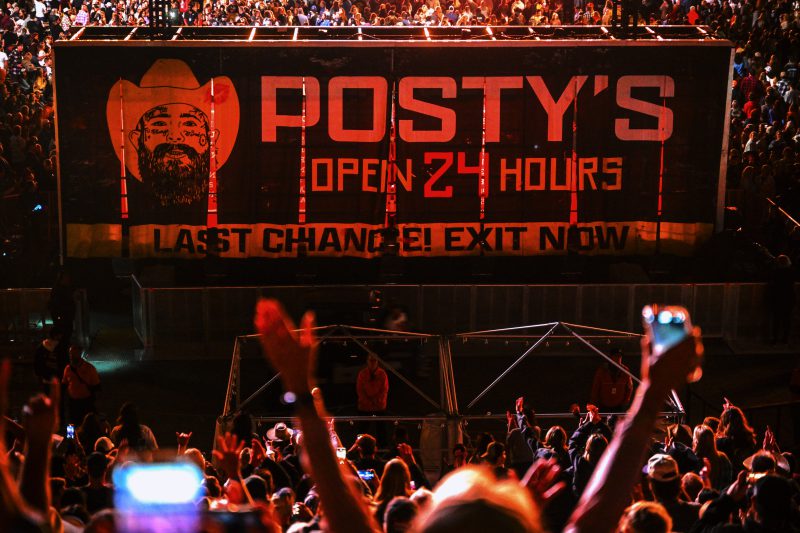
The billboard was a way to allow the artist to move out into the crowd and to see the audience in the stands up close, which is difficult to achieve in a large outdoor stadium. We were lucky that the ‘Roadside America’ theme gave us the perfect playground of ideas to draw from so we could achieve these different elements.
RZ: Americana often carries a mix of nostalgia and mythology. How did you interpret these cultural references visually while keeping the design relevant to Post Malone’s identity and music?
RD: Much of the video content for the show was shot in Utah, using anamorphic film. This allowed us to achieve a very cinematic and theatrical look, with a perspective that felt both distinctive and specific to the artist. Utah also happens to be one of the most dramatic and beautiful landscapes in America, which added to the impact.
We drew from traditional roadside architecture but with a twist to make it unique to Post Malone. For example, in Las Vegas we created two enormous signs inspired by the iconic strip neon figures, the Pioneer Man and the Kicking Cowgirl. Our designs were reimagined with playful details. The cowboy waves, has a cigarette with a glowing tip, and wears a giant Post Malone style belt buckle, while the cowgirl blows kisses instead of kicking. As well as appearing as a traditional Vegas sign, flashing and waving at the crowd, these set pieces also move us along the journey we are all taking along the road, sometimes strobing to the rhythm and sometimes more serious and motionless.
We also played with supersized roadside Americana, like the world’s biggest belt buckle, which resonated perfectly because Post Malone is known for his ornate belt buckles. We designed a massive version to sit on the roof of the structure, and it became a real centerpiece for the design.
To get these details right, we collaborated closely with Post Malone’s graphic designer Grant Kratzer, who helped us put just the right spin on each element so it felt authentic to him while still tapping into the spirit of roadside Americana.
RZ: STUFISH has collaborated with global icons from Beyoncé to The Rolling Stones. How was working with Post Malone different, and what unique input did he bring to the creative process?
RD: He was such a wonderful person to work with, very kind, humble, and very open. He really gave us a lot of his mandate to push the limits. A lot of his comments were, “can we make it bigger”? It was a very fun artist to work for and very appreciative.
RZ: The surprise billboard that emerges from the audience is one of the most striking features. Can you walk us through the engineering and creative thinking behind this moment?
RD: The billboard was originally an idea for Post Malone’s Coachella performance earlier this year. We wanted a moment where he would be able to appear out to the crowd and rise up. To make that happen, we had to engineer it so that it collapsed when not in use. When it was down, it needed to be completely hidden and not cause any sight obstructions.
We had a strict mandate from Coachella that it could be no taller than five feet when collapsed, so we had to design it so the sides hinged inward and folded down. It was a real challenge, and we worked closely with engineering company TAIT to build it.
On top of the structural constraints, we had weight restrictions and a huge amount of integrated lighting. The billboard strobed and flashed as it rose, which created a dramatic effect. For the stadium shows, we wanted to add another layer of surprise, so we developed a reveal inside the billboard. Working with Grant Kratzer we created fabric graphics that dropped away as it lifted, unveiling him inside.
Fully extended, it’s a massive piece. The structure is about 30’ tall at maximum trim, yet it operates very smoothly. Of course, we had to prioritise safety, so there’s an integrated harness system built into the billboard to ensure he’s secure whenever it’s in use.
RZ: Stadium shows demand a delicate balance between intimacy and spectacle. What design strategies did you use to make such a vast space feel personal and immersive?
RD: Creating something that feels intimate in a vast space isn’t just about staging, it’s also about shaping the moment you want to achieve. From our side, we designed spaces, where the artist could get away from the busyness of the main stage and have these intimate moments. We built a B-stage and additional performance spots far stage left and right, where he could connect with the audience in a more personal way. In the first show of the American leg, he came out with just a guitar and performed at the end of the B-stage. It was a beautiful contrast to the big, visually driven production that sometimes the main stage embodies.
RZ: Looking ahead, how do you see large-scale live show design evolving—especially in terms of storytelling, technology, and audience engagement?
RD: It’s very hard to say as the world of live entertainment moves so quickly. Right now, there seems to be a movement back towards physical scenery and theatricality, which is really fun and very joyous, which I hope continues. We’re also seeing more shows with strong narrative elements, which is exciting, because it allows technology to serve the story rather than overshadow it. For STUFISH, the heart of live design will always be about creating a communal experience and bringing people together to share something special.