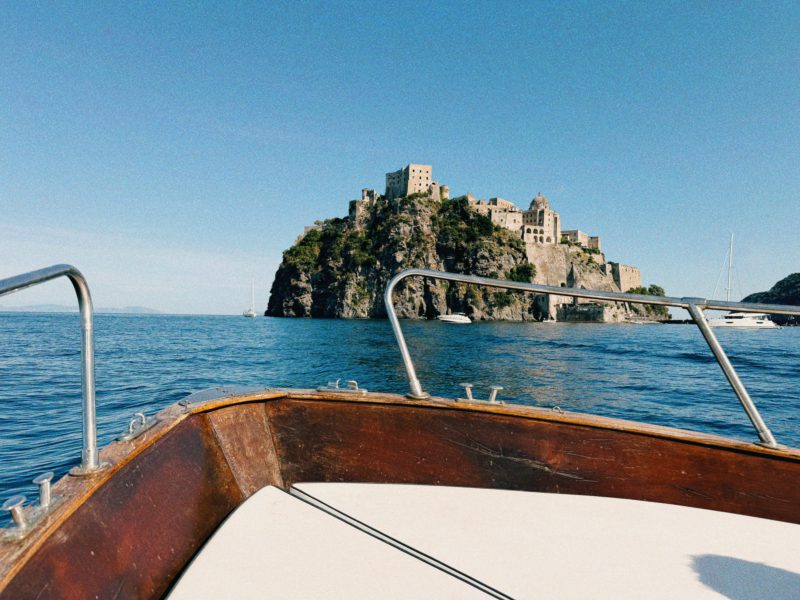
The first glimpse arrives before the island does. From the ferry, as Ischia draws nearer in the afternoon, the Castello Aragonese appears to rise directly from the Mediterranean: a mass of stone crowned by pale buildings, suspended between the blue of the water and the blue of the sky. At that hour, the sun falls across its walls with the improbable softness of cinema. The fortress seems less constructed than conjured, waiting offshore like a mirage.
Only after disembarking does its geography become clear. The Castello occupies its own trachytic-rock islet, separated from Ischia by a narrow strip of sea and joined to it by a 230-meter-long masonry bridge. To reach Il Monastero, the hotel hidden near its summit, one must cross the bridge in its entirety, enter the base of the rock and step into an elevator that ascends through a tunnel carved into the mountain. The journey takes barely a minute, yet it feels like a passage between worlds.
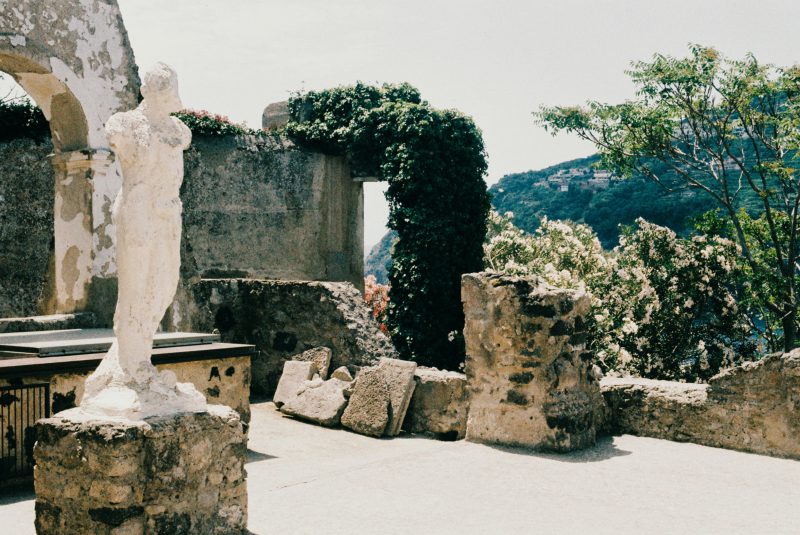
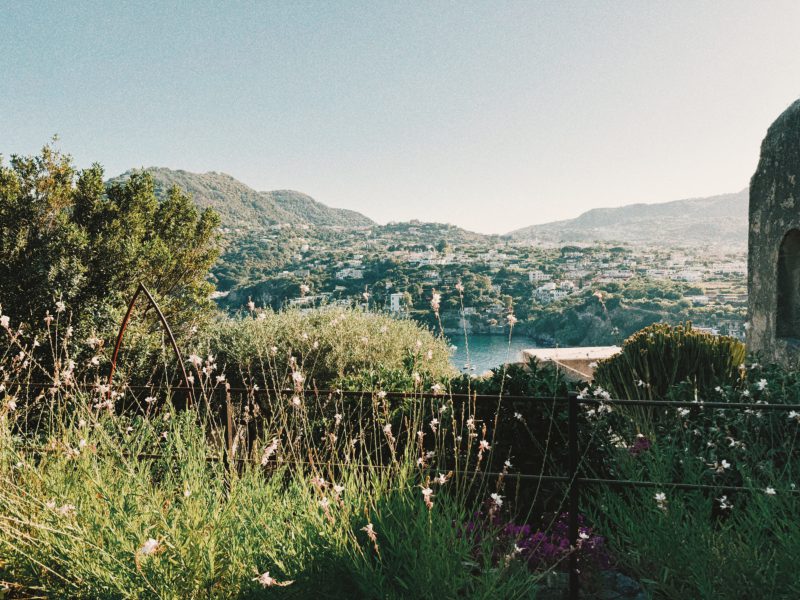
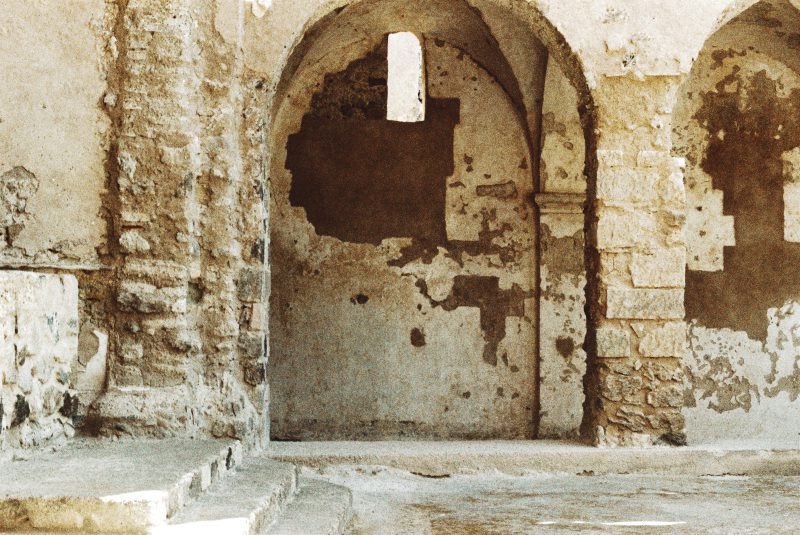
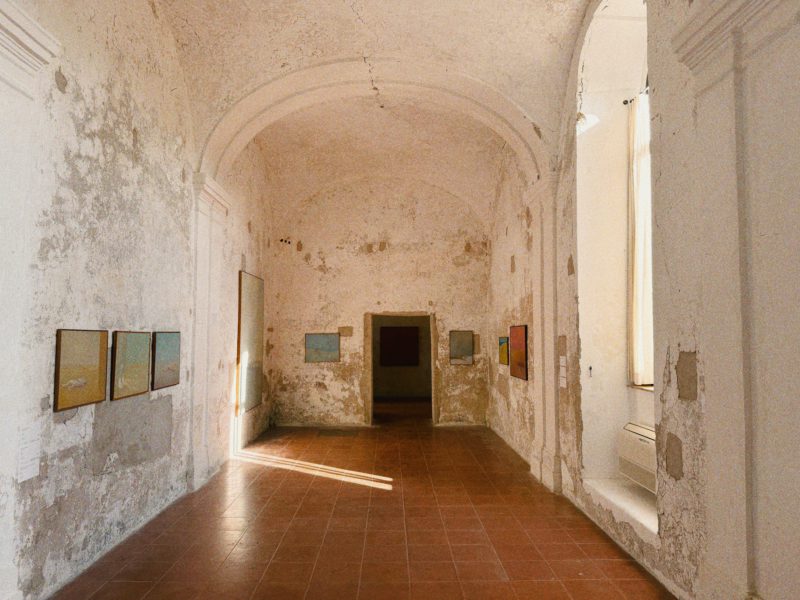
Emerging at the top, I was met by a panorama so expansive that, for a moment, the hotel itself seemed secondary. Ischia unfolded below in a succession of tiled roofs, green hills and crescent-shaped coves. Beyond it were Procida and Vivara, and farther still the hazy outline of the Campanian coast. The Mediterranean stretched outward until distance dissolved its edges. It was easy to feel caught inside the sun-dazed world of The Talented Mr. Ripley, which found part of its Italy here. Il Monastero occupies a former convent founded in 1575 for cloistered Clarisse nuns. Its 19 rooms and two suites retain something of their original cells: whitewashed walls, vaulted ceilings and a deliberate scarcity of furniture. Wrought-iron beds, locally made pieces and blue majolica floors provide the decoration. Yet austerity here does not feel like deprivation. The absence of excess directs one’s attention toward other things—the movement of light, the cries of gulls, the texture of old plaster and the sea framed by a window.
The hotel grew from an appropriately spare form of hospitality. Beginning in the 1970s, travelers wishing to sleep in the abandoned convent were given sheets and candles for the night—and, in the earliest days, a bucket of water. It was a romantic, if rudimentary, arrangement that became the foundation for what was then called L’Albergo del Monastero. The construction of the elevator through the volcanic rock made hospitality, and the transportation of life’s necessities, considerably easier.
The Castello itself had been purchased from the Italian state in 1912 by the lawyer Nicola Ernesto Mattera: 25,000 lire for what amounted to 25 centuries of neglected history. Its fortress, prisons, churches, gardens and convent stood largely in ruins. Today, the third generation of the Mattera family continues the work of restoring it—not as a relic sealed off from life, but as an inhabited cultural landscape.
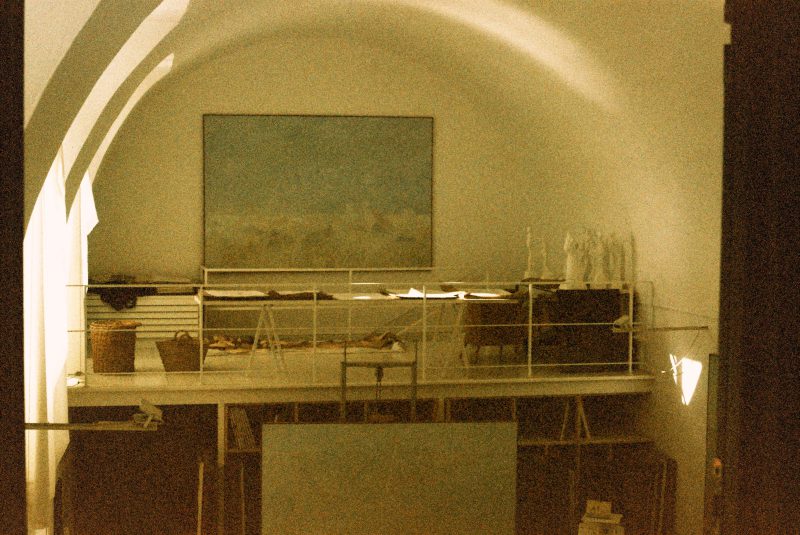
Over breakfast, I met Anna Cristina Mattera, whose parents, the painter Gabriele Mattera and the German graphic designer Karin Mattera, helped revive the Castello beginning in the 1970s. Cristina spoke of their life among its ruins and of the artists who gathered there. Her father’s paintings now hang throughout the hotel, not as decorative afterthoughts but as extensions of the architecture. Their colors appear to have been chosen in conversation with the chalky walls, volcanic earth and mutable blues of the sea.
Art is everywhere, though rarely announced. Works by family friends and artists who have passed through the Castello occupy corridors and dining rooms. The former refectory of the nuns, later Gabriele’s studio, has become loStudio, a shop devoted to carefully selected Italian art and craft. Outside, the old hortus conclusus has been transformed into a luminous garden of vines, vegetables and native plants. In the afternoon, its leaves seem to hold the sunlight.
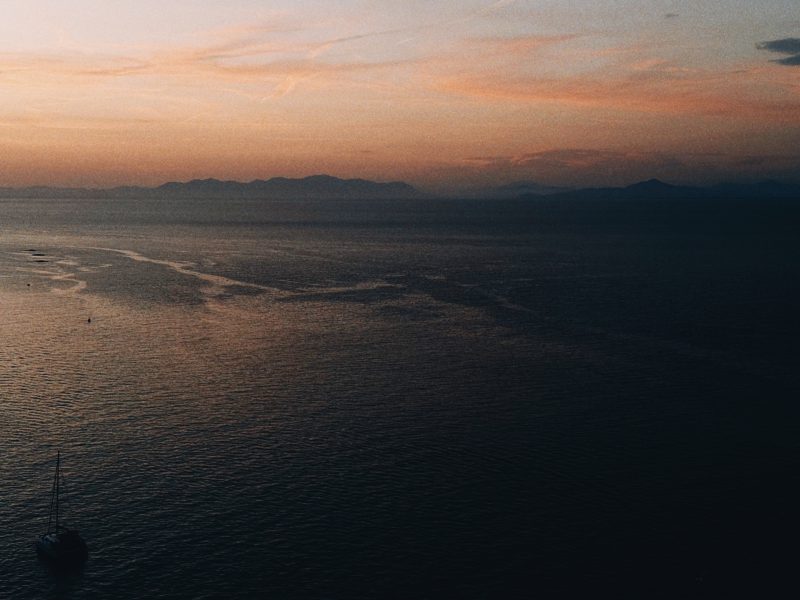
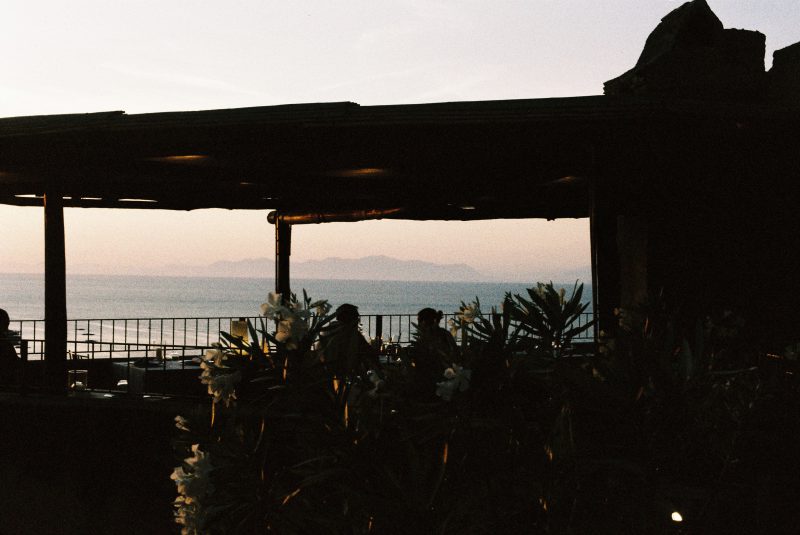
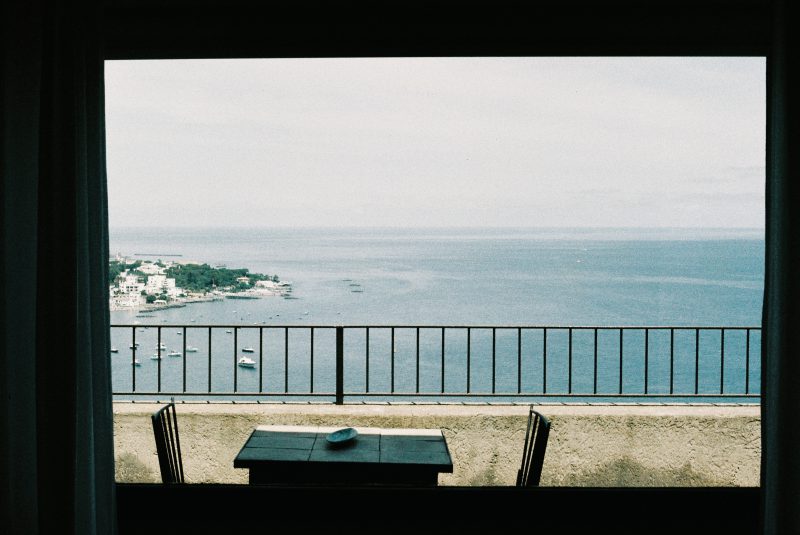
Meals are served on a terrace where the view renders conversation momentarily unnecessary. At breakfast, lunch and dinner, Ischia appears in a different register: pearly in the morning, sharply colored at noon, then gradually softened by dusk. From this height, the island looks both near enough to touch and impossibly remote. The effect is not unlike dining on another planet—one with excellent pasta and a sea breeze.
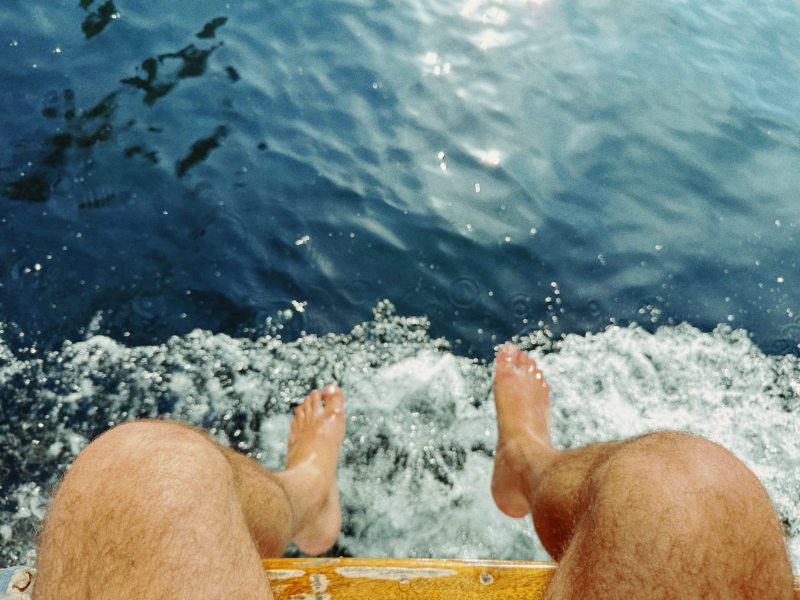
The following day, from a boat circling the Castello, I saw the rock from below. We swam beneath its walls, where volcanic bubbles rose through the water and broke silently at the surface. Above us were centuries of fortification, faith, abandonment and repair; below, the island remained geologically alive.
Many hotels attempt to manufacture a sense of escape. Il Monastero offers something stranger and more affecting: the privilege of briefly entering a place shaped by time rather than designed against it. Its beauty is not immaculate. It lies in the accumulated intention—in every repaired vault, planted terrace, inherited painting and wall left bearing the evidence of age. The Matteras have spent generations making a masterpiece, though perhaps their greatest achievement has been knowing where not to interfere. Here, light remains the principal architect, the sea the dominant artwork and silence the rarest luxury of all.