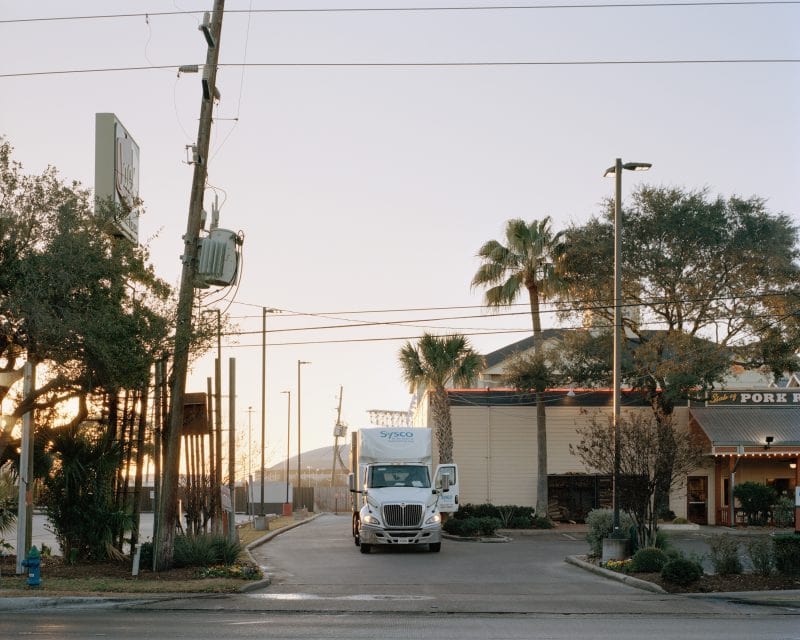
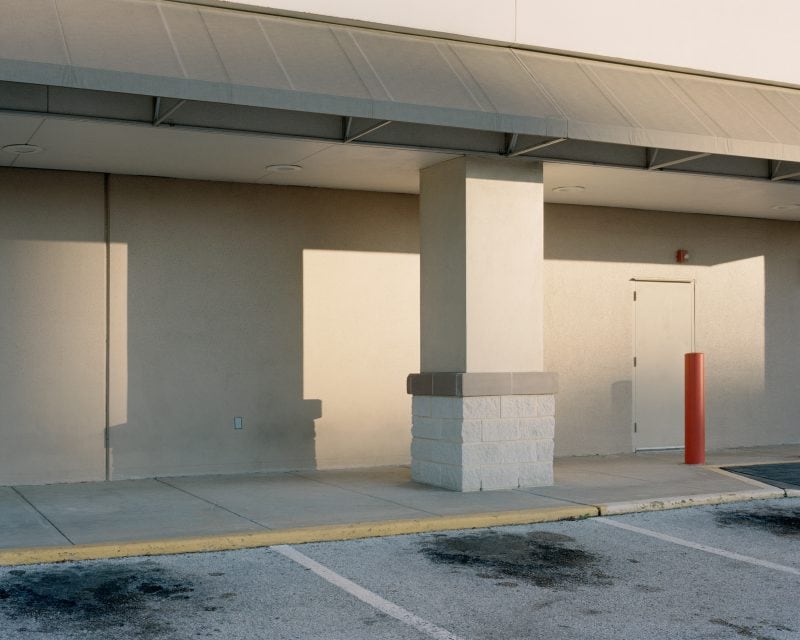
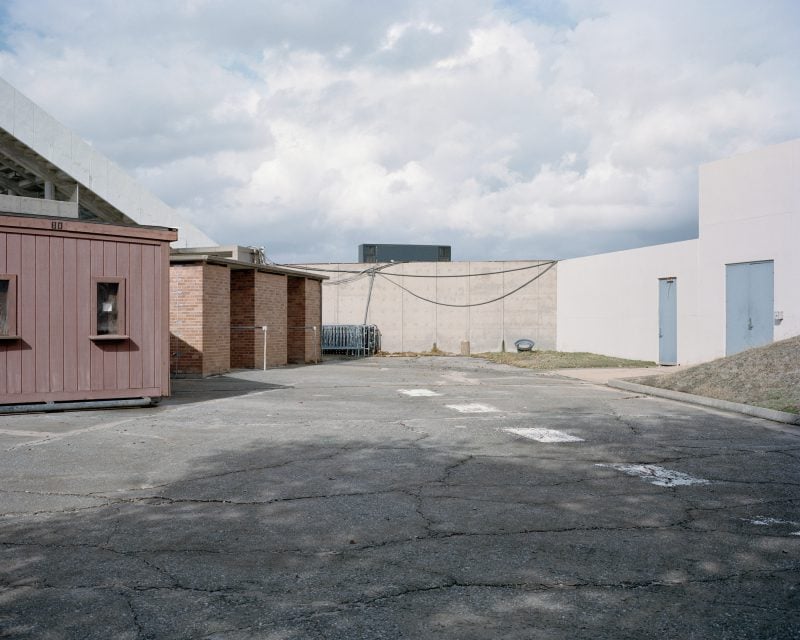
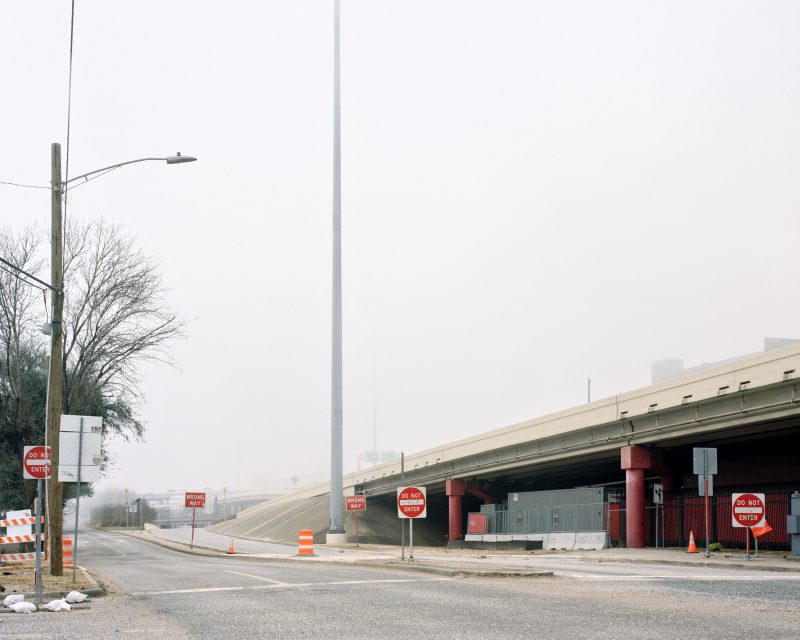
In Rory Gardiner’s photographs, Houston appears as a city designed for future events. Empty car parks, motorway flyovers, concrete corridors and facades devoid of signage outline a landscape in which the architecture remains, whilst people are temporarily absent. Houston, Untitled, produced as part of the Houston Archive Project at the Rice School of Architecture, originated from a commission focusing on two city landmarks, Rice Stadium and the Astrodome, but Gardiner soon broadened his observation to include the surrounding areas. The twenty-one photographs, taken in February 2026, are not organised by location or type. Even the titles avoid descriptive language, being reduced to geographical coordinates. This choice, almost administrative in nature, contrasts with the atmospheric tone of the images. In 29.749394, –95.358120, a road vanishes into the fog whilst a series of ‘Do Not Enter’ and ‘Wrong Way’ signs transforms the road signage into a system of directions devoid of any apparent logic. In 29.691110, –95.413818, the late-afternoon light casts sharp rectangles onto the nondescript wall of a commercial building. The city takes the form of a collection of surfaces, gaps and obstacles.
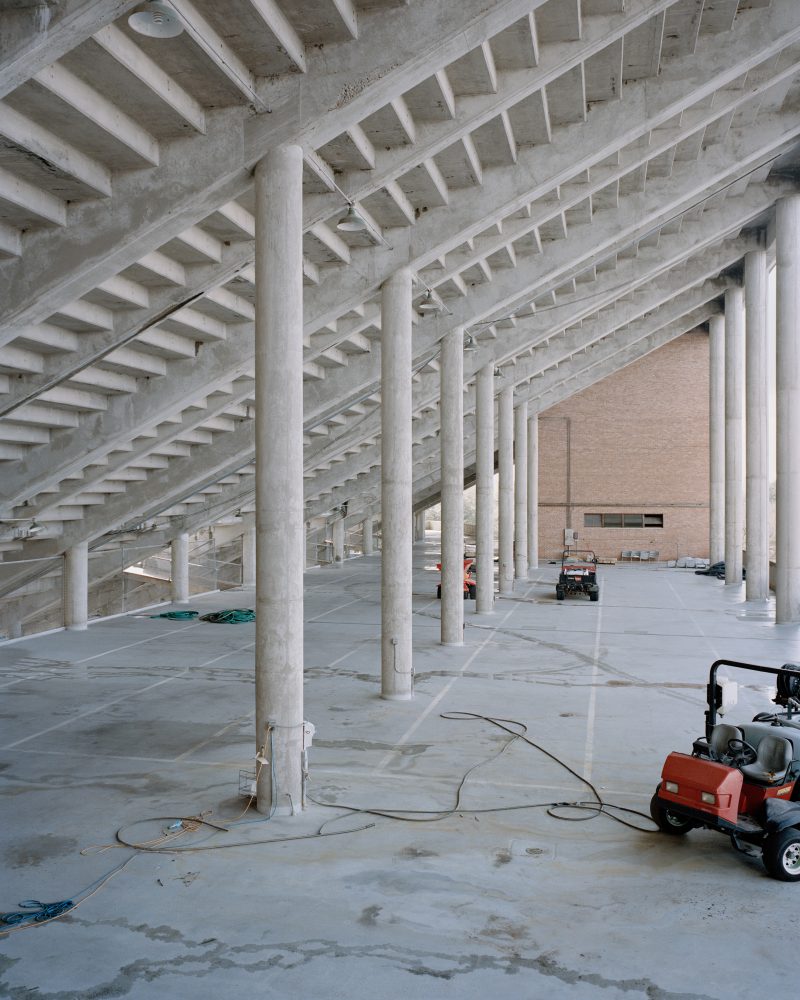
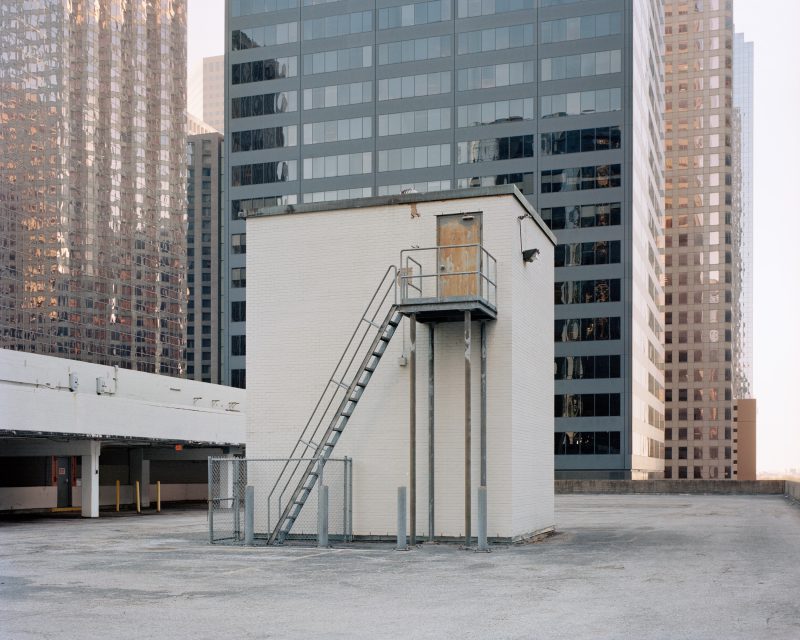
One can see the influence of American photography by Stephen Shore and Lewis Baltz in the focus on ordinary elements: infrastructure, car parks, service buildings. Gardiner, however, refrains from both celebration and explicit criticism. His portrait of Houston is not spectacular, nor does it aspire to be. Even in the case of Rice Stadium, the monument loses its centrality. Beneath the stands, the repetition of the concrete pillars creates a structure in its own right; small maintenance vehicles, cables and pipes left on the floor indicate the human scale without showing it directly. It is a suggested presence. The same is true of the car park surrounded by skyscrapers, where a small building with an external staircase appears fragile compared to the surrounding towers. Gardiner describes Houston as a city that is difficult to interpret from ground level: flat, repetitive, governed by grids that do not lead to a definitive form. It is in this respect that *Houston, Untitled* transcends a purely architectural study. The archive does not merely preserve what a city considers significant. It also preserves its in-between spaces: what remains between one event and the next, when the stadium is empty, the vehicle is parked, and the city simply continues to exist. Houston, Untitled is on display at the Rice School of Architecture from 25 September to 5 December 2026.